 |
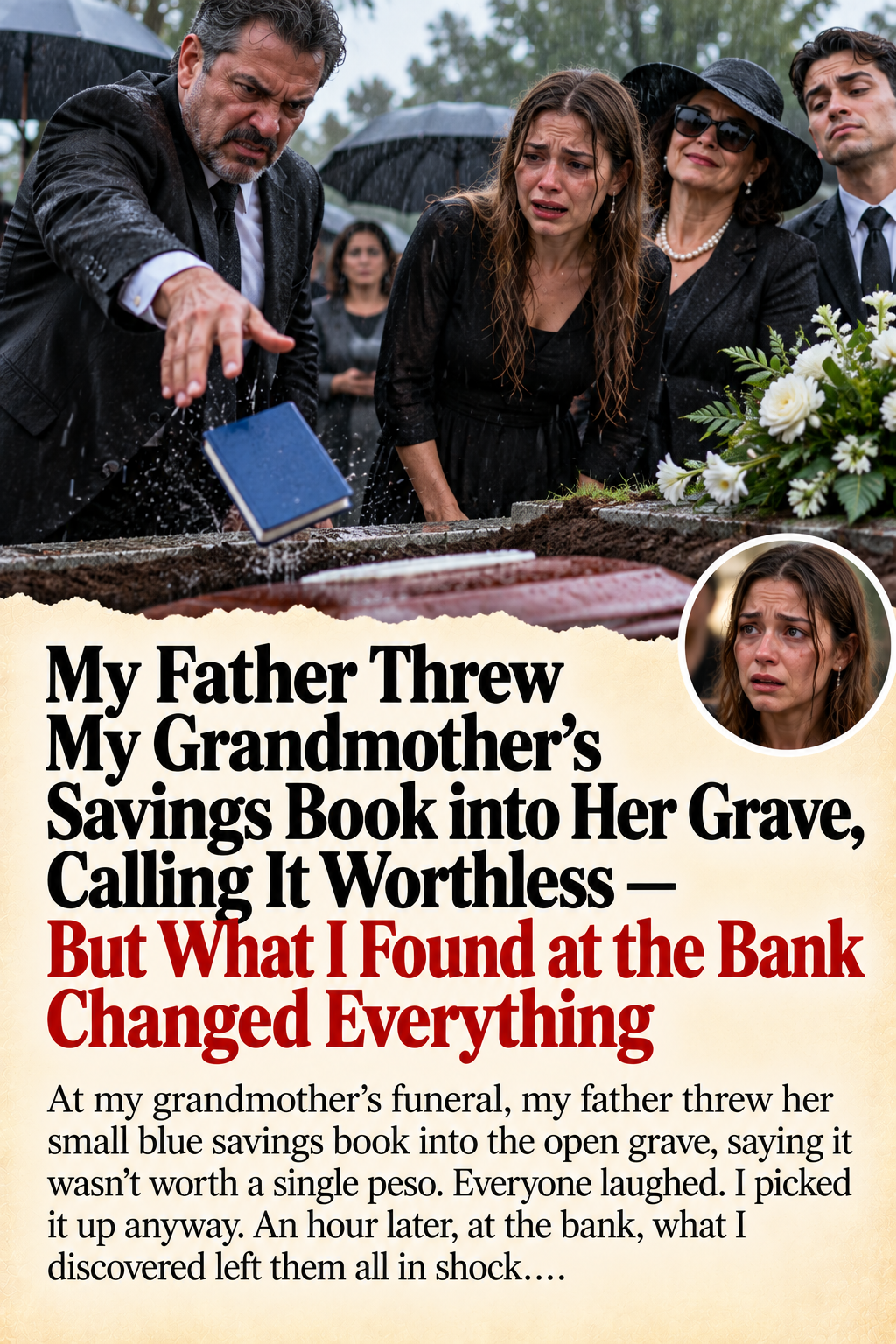
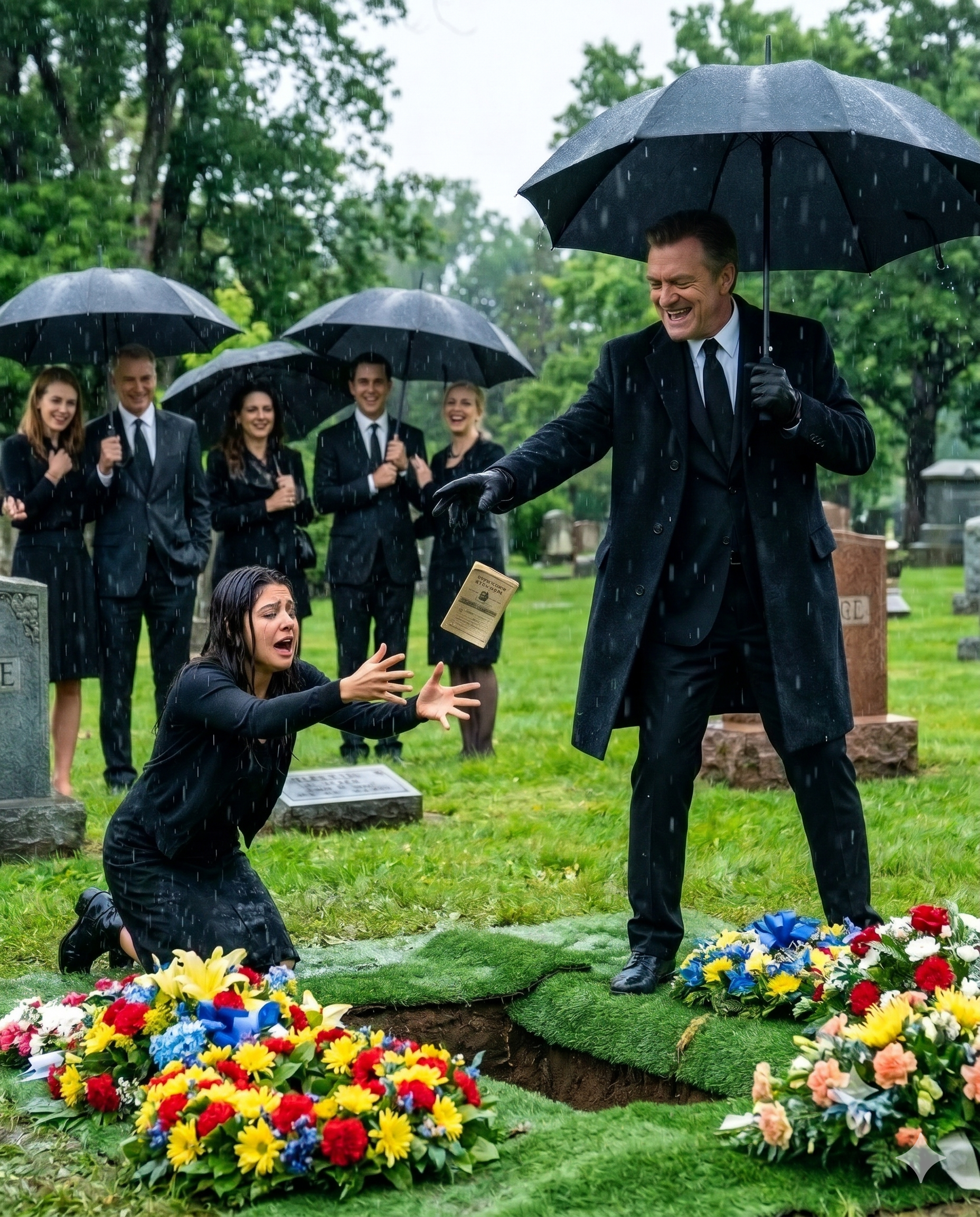
My father waited until my grandmother Lupita’s funeral was nearly over before throwing the small blue savings book into her open grave.
Rain poured down over the cemetery in Querétaro, Mexico, turning the pathways into muddy puddles. The relatives standing beneath the funeral tent watched in silence as the book fell, landing beside the coffin of the woman who had raised me.
“This thing isn’t worth a single peso. Let it rot with the old woman!”
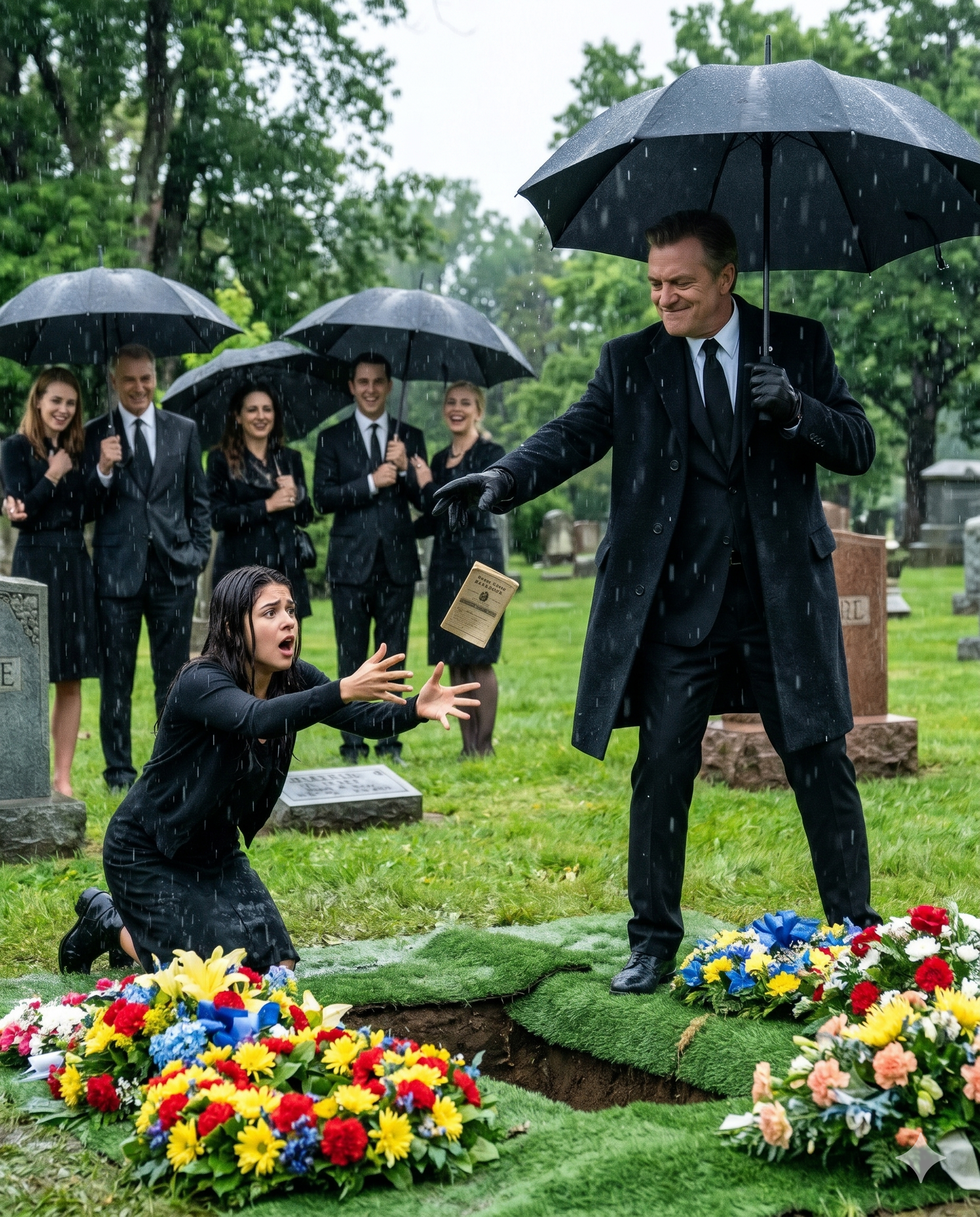
My father, Víctor Salazar, brushed his hands together as if he had just thrown away a piece of trash.
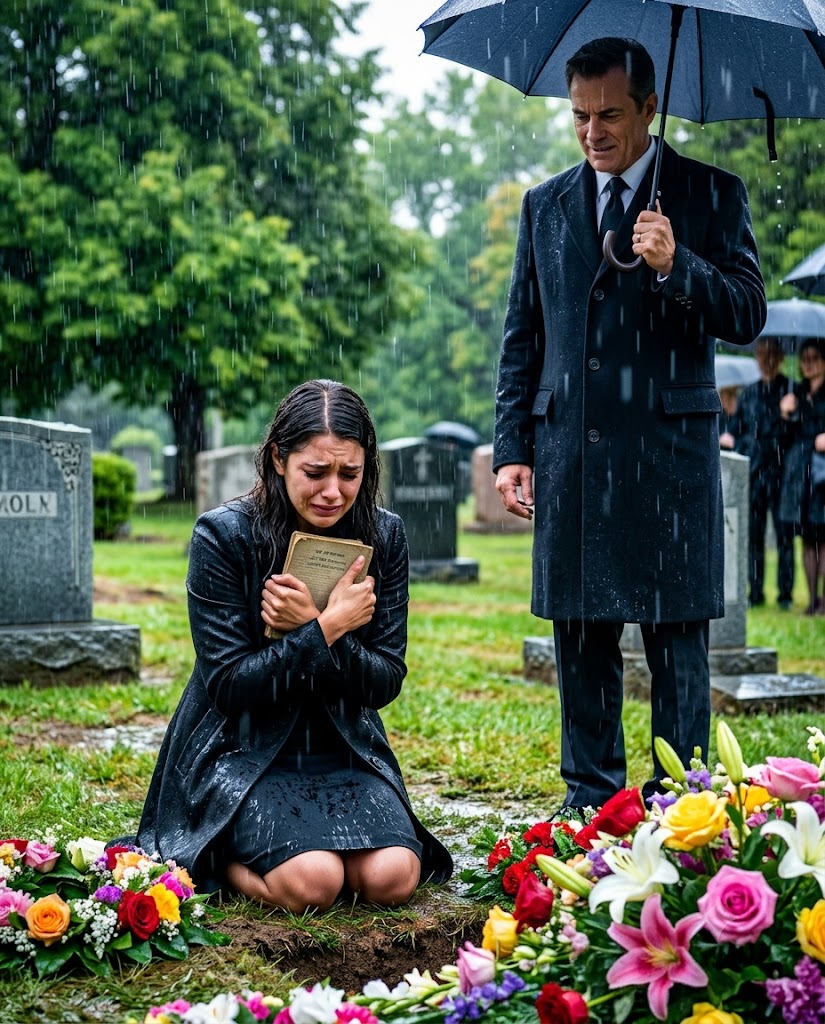
I stood frozen in my borrowed black dress, my hands numb from the rain. I was only twenty-seven, but the deepest pain I felt had nothing to do with the weather. It came from realizing that my own father could humiliate his recently deceased mother without feeling the slightest shame.
My stepmother, Patricia, chuckled softly behind her dark sunglasses. Diego, my half-brother, tilted his head toward the book and sneered.
“If there’s even fifty pesos in there, sis, you’d better treat me to tacos!”
Several relatives laughed along.
No one defended me. No one objected to the way my father was treating the last possession my grandmother had left behind.
Twenty minutes earlier, the notary, Mr. Arriaga, had read my grandmother’s will in front of the entire family.
She had left me the savings book and all the rights associated with it.
That was all.
No houses, no land, and no other assets were mentioned in the portion of the inheritance assigned to me. My father received nothing, and that was precisely why he was so furious that he could barely hide it.
He had always believed that everything my grandmother owned would eventually belong to him.
But she had chosen otherwise.
After my mother, Lidia, died in a car accident when I was five, my grandmother was the only person who opened her arms and took me in. She taught me how to cook, pay bills, read documents carefully before signing them, and never let anyone intimidate me into making a decision.
My father had never truly cared about me. He often made me feel like a burden, while my grandmother reminded me that I never needed to apologize simply for existing.
A week before she died, she lay in her hospital bed and held my hand with her frail fingers.
“Mariana, if they laugh at you one day, let them.”
I leaned closer to her.
“Then what should I do, Grandma?”
She looked straight into my eyes.
“Go to the bank.”
At the time, I didn’t understand what she meant.
But as I watched the little book lying in the rain, I knew I couldn’t leave it there.
I stepped toward the coffin.
My father immediately grabbed my arm.
“Don’t do anything stupid!”
“Let go of me.”
He tightened his grip.
“Don’t make a fool of yourself in front of everyone, Mariana.”
I looked at him, struggling to keep my voice steady.
“You’ve already done that for me, Dad.”
I pulled my arm free, stepped into the muddy ground, and picked up the book. Mud covered its worn blue cover, but I carefully brushed away as much dirt as I could before pressing it against my chest.
My father approached me. The strong smell of alcohol on his breath made me feel sick.
“Your grandmother couldn’t even keep her own house. You really think she could have left you anything?”
I didn’t answer.
For the first time, I realized that my grandmother had known exactly how my father would react.
I slipped the book into my handbag and walked toward the cemetery gate.
Diego blocked my path.
“Where are you going?”
I looked past his shoulder toward the road, now flooded with rainwater.
“To the bank.”
Laughter erupted behind me. My father laughed louder than anyone.
Only the notary, Mr. Arriaga, remained silent. Standing beneath the tent, he watched me leave with a grave expression, as if he knew the book concealed something my family could never have imagined.
My black dress was still wet. Mud clung to the heels of my shoes. I placed the book on the counter and explained to the teller, a woman named Maribel, that it had belonged to my grandmother.
She opened it, checked the information, and entered the details into her computer.
At first, everything seemed normal.
Until she read my full name.
Maribel’s expression changed instantly. She looked at the book, then at me, and then back at the screen. Her fingers trembled as she picked up the phone.
“Call the police. Lock the doors. This young woman must not leave.”
My heart nearly stopped.
“Why are you calling the police? Have I done something wrong?”
Maribel hurried out from behind the counter and lowered her voice.
“No, Ms. Mariana. You’re not being accused of anything. But this account has special instructions dating back many years.”
The branch manager, Carmen Rivas, quickly escorted me into a private room. She placed the book on the table as if it were no longer an ordinary savings book but a crucial piece of evidence.
“Your grandmother left very specific instructions,” Carmen explained. “If you came here in person with the original book, we were required to verify your identity, notify the authorities, and protect all related records.”
I stared at her.
“Protect them from whom?”
Carmen remained silent.
I already knew the answer.
“My father, didn’t I?”
She nodded slightly.
Then Carmen said something that turned my entire world upside down.
My father had tried to close this account three times.
The first attempt had occurred when I was thirteen.
He had brought the bank a death certificate bearing my name.
A forged death certificate.
I was stunned.
“That’s impossible. I was alive!”
“Your grandmother brought you here the following day,” Carmen said. “She instructed us never to release the funds or make any changes unless we saw you in person.”
A vague memory suddenly returned. I remembered sitting beside my grandmother in the bank lobby. An employee had given me a tamarind candy, and my grandmother had remained silent throughout the bus ride home.
At the time, I thought she was simply tired.
Now, at twenty-seven, I finally understood what she had been dealing with.
My own father had tried to convince a bank that his daughter was dead so he could steal her assets.
Not long afterward, two investigators arrived. Commander Valeria Montes reassured me that I was not under arrest. They needed to ensure my safety and examine the records my grandmother had instructed the bank to preserve.
Just then, the notary, Mr. Arriaga, arrived carrying a yellow envelope.
My grandmother had instructed him to deliver it to me only if I went to the bank on my own.
Inside was a small key and a letter written in her familiar handwriting.
“My granddaughter, if you are reading these words, it means you have been braver than they expected. That book is not money. It is a doorway.”
I continued reading through my tears.
She wrote that my father had taken what my mother had left me, stolen the documents to our family home, and spent years trying to make me believe I had never been entitled to anything.
The book was merely a sign pointing toward the truth.
Carmen led us down to the bank’s safety deposit vault. The key in the envelope opened box number 117 when used with the bank’s key.
I had imagined finding gold, jewelry, or a huge amount of cash inside.
Instead, the first thing I saw was a collection of neatly arranged envelopes.
The first was labeled: FOR MARIANA — FINANCIAL ASSETS.
Inside were investment certificates, insurance documents, bank statements, and financial records preserved over many years.
At the bottom of the file was a number that forced me to look twice.
23,480,000 pesos.
“I can’t have that much money,” I whispered.
Carmen shook her head.
“Your mother had insurance, investments, and real estate. Your grandmother protected those assets through several financial arrangements. She lived very frugally so your father wouldn’t suspect how much wealth remained.”
I remembered my grandmother’s repeatedly mended sweaters, her simple meals, and the way she carefully calculated every peso at the market.
She had made her life look as if she owned nothing of value, all to protect what belonged to me.
The second envelope was labeled: THE HOUSE.
I immediately recognized the documents inside. They belonged to the white house in Colonia Álamos, where bougainvillea once surrounded the garden and my last childhood memories of my mother had been made.
My father had sold that house when I was thirteen. He told me my grandmother could no longer afford to keep it.
But the documents in front of me proved otherwise.
The house had never belonged to my grandmother.
It belonged to me.
Before she died, my mother had placed the house in a trust under my name. My father had used forged documents, counterfeit signatures, and a company connected to Patricia’s brother to sell the property.
I couldn’t believe that the man had spent years constructing a web of lies designed to steal both his daughter’s money and her future.
At that moment, a violent pounding echoed from the bank’s front entrance.
“Open the door! My daughter is stealing our family’s documents!”
I looked through the gap in the curtains.
My father stood outside the glass doors, his funeral clothes still soaked from the rain. Patricia stood beside him, while Diego held up his phone and recorded everything.
When my father saw me, his lips moved. He mouthed a single word.
“Mine.”
Commander Montes immediately headed toward the entrance with two officers.
“Víctor Salazar, you need to come with us.”
My father protested at once.
“This is a family matter!”
The commander looked directly at him.
“No. This is evidence now.”
Patricia tried to retreat toward the parking lot, but an officer stopped her. Diego slowly lowered his phone. For the first time, my half-brother seemed to understand that our father couldn’t control everything simply by raising his voice.
However, there was still one envelope inside the safety deposit box.
It was labeled: FOR THE POLICE — REGARDING LIDIA.
Lidia was my mother.
Commander Montes put on gloves and opened the envelope. Inside were photographs of the crashed car, repair invoices, and a USB drive my grandmother had kept for more than twenty years.
After examining the first few documents, she looked up at me.
“Mariana, these materials could completely change what you believe about your mother’s death.”
For twenty-two years, I had believed my mother died in an unfortunate car accident on a road made slippery by rain.
But my grandmother had spent those same years preserving evidence suggesting that the accident might not have been an accident at all.
The USB drive contained recordings my grandmother had secretly preserved.
In one recording, I heard her confronting my father about the accounts he had tried to seize and the forged death certificate bearing my name.
“I know what you did, Víctor. I know you tried to have Mariana declared dead.”
My father replied coldly.
“You can’t prove anything.”
My grandmother refused to back down.
“I also know Lidia wanted to leave you.”
A long silence followed.
Then my father said something that sent a chill down my spine.
“Some women realize too late what happens when they try to walk away.”
I had to stop the recording.
My mother had died while trying to leave my father.
And my grandmother had preserved the words that might explain why.
The investigation was reopened. Investigators discovered payments my father had made to a mechanic shortly before the accident, photographs showing signs of tampering with the brake lines, and irregularities in the original investigation records.
The mechanic was now elderly and seriously ill, but he eventually admitted that my father had paid him to sabotage my mother’s car.
According to his statement, Víctor wanted to frighten my mother into abandoning her plan to leave with me and the house. He had not expected the situation to end in her death, but sabotaging the car during heavy rain turned his threat into an irreversible tragedy.
I didn’t cry when I heard the findings.
I simply sat still, staring at the mud-stained blue book in front of me.
My father had thrown it into my grandmother’s grave, believing he had just destroyed the final threat to the lies he had built over so many years.
He had no idea that my grandmother had prepared for this day long ago.
The following months became a long sequence of interviews, hearings, and legal arguments. Some relatives still tried to persuade me to remain silent, insisting that family matters should never be brought into the open.
But I had come to understand that this silence was exactly what had allowed my father to keep controlling my life.
Bank records confirmed that he had repeatedly attempted to seize my account. The notary, Mr. Arriaga, also proved that the house had been sold using forged documents. Investigators found further evidence implicating Patricia in efforts to access the account and manipulate the inheritance records.
Even Diego eventually agreed to testify.
“Dad hates Mariana because she reminds him of Lidia.”
Hearing those words hurt more than I expected. The years of emotional neglect, the contemptuous looks, and the unreasonable accusations suddenly had a horrifying explanation.
Perhaps every time my father looked at me, he saw the woman who had tried to escape him.
During the trial, another recording was played before the jury.
My grandmother’s voice rang out clearly.
“Tell me why, Víctor.”
My father replied:
“Because she was going to take what belonged to me.”
“Lidia was not your property.”
“My daughter won’t belong to her, either!”
My grandmother continued.
“Did you cut the brake line?”
A long silence followed.
Eventually, the words and evidence she had preserved for more than twenty years became an important part of the case.
My father was convicted of fraud, forgery, financial exploitation of an elderly person, and murder. Patricia also received a prison sentence for her involvement in the conspiracy, while those connected to the fraudulent property transaction were investigated and prosecuted under the law.
At the sentencing hearing, I stood before the judge, holding the same blue book my father had once thrown into my grandmother’s grave.
I looked at the man who had made my childhood a place of fear.
“My father called this book worthless. But it carried my grandmother’s courage, my mother’s protection, and the truth he tried to bury.”
I tightened my grip on the worn cover.
“He simply didn’t bury it deep enough.”
The paint was peeling. The bougainvillea had grown wild. The old door creaked as I stepped inside, but at that moment, I felt as though a lost part of my childhood had been waiting for me to come home.
In the kitchen, I found the pencil marks on the wall that had recorded my height when I was little.
“Mariana, four years old.”
“Mariana, five years old.”
Above those marks was another faded inscription.
“Lidia, first key, nineteen years old.”
This time, I broke down in tears.
Not because of the money my father had tried to steal. Not even because of all the years I had lived surrounded by lies.
I cried because, at last, the things I thought I had lost forever had found their way back to me.
The inheritance was also restored. The more than twenty-three million pesos my grandmother had protected for years finally belonged to me.
But by then, money was no longer the most important thing.
My grandmother had protected the evidence.
She had protected my right to choose.
Above all, she had protected my right to decide what kind of life I wanted to live.
I used part of the recovered assets to establish a foundation in honor of Guadalupe and Lidia, helping women and children trying to escape domestic violence and financial control within their own families.
The first woman who came to the foundation was named Ana. She held a sleeping baby in her arms and kept adjusting her makeup as though trying to hide the bruise on her face.
“I’m sorry to bother you.”
I placed a folder in front of her containing information about temporary housing, legal assistance, and financial support.
“You don’t have to apologize for needing help here.”
As I said those words, I suddenly understood what my grandmother had truly left me.
It wasn’t just money, documents, or an old house. It was the ability to turn everything she had fought to protect into protection for others.
I restored the garden, repaired the walls, and left the pencil marks in the kitchen untouched. Gradually, the house became a place where women could turn when they needed a chance to start over.
As for the little blue savings book, I had it framed and hung near the entrance.
I deliberately preserved a stain of mud on its cover, right where it had fallen into my grandmother’s grave.
Beneath the frame, I engraved her final instruction.
“When they laugh at you, let them. Then go to the bank.”
Sometimes, visitors ask why I don’t keep such an important object locked away in a safe.
I always give them the same answer.
That book had been hidden in fear for long enough.
My grandmother didn’t protect it so I could spend the rest of my life worrying that someone might take it from me one day.
She protected it so I could understand that the value of something does not disappear just because someone powerful declares it worthless.
Ownership does not disappear simply because a relative decides they deserve what belongs to you.
And the truth does not disappear just because an entire family agrees to remain silent.
My father threw the book into my grandmother’s grave because he believed he was burying the last threat to the life he had built on lies.
But the very object he had mocked led me back to my mother, to my home, to the inheritance that had been stolen from me, and to the truth my grandmother had spent her life protecting.
I once thought she had left me nothing more than an old savings book.
Now I know she left me much more than that.
She left me the chance to reclaim my life—and the strength to help others do the same.
Because family can be a place of love, but blood ties never give anyone the right to seize your property, distort your memories, or decide how you should live.
Some truths remain buried for years.
But once someone finds the courage to dig them up, no amount of money, no threat, and no family name can make them disappear again.
More stories to explore
Family Celebrated When Their Missing Son Returned After 3 Years — Until Police Discovered Who He Really Was
I Was Removing a 6-Year-Old Girl’s Cast When I Felt Something Strange — What Happened Next Sent the Entire Hospital Into Emergency Mode