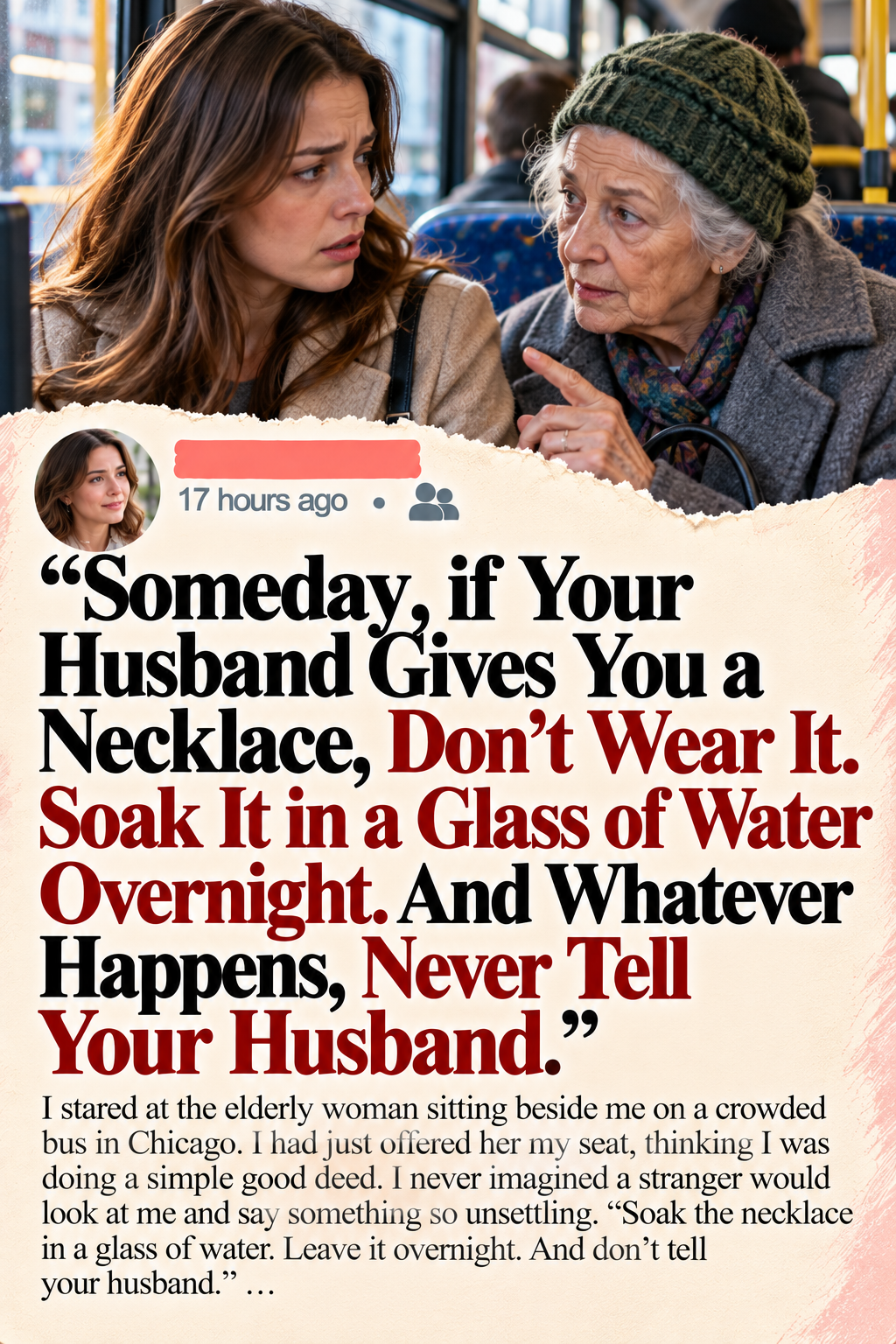
“Someday, if your husband gives you a necklace, don’t wear it. Soak it in a glass of water overnight. And whatever happens, never tell your husband.”
I stared at the elderly woman sitting beside me on a crowded bus in Chicago.
Just minutes earlier, I had offered her my seat after noticing how difficult it was for her to stand among the passengers. She wore a long gray coat, a green knitted hat, and carried the faint scent of lavender.
I had thought I was simply doing an ordinary good deed.
I never imagined that this stranger would say something so unsettling.
“I’m sorry, what did you just say?”
She looked directly into my eyes. Her gaze was far too sharp for someone making a joke.
“Soak the necklace in a glass of water. Leave it overnight. And don’t tell your husband.”
For illustrative purposes only
A chill ran down my spine.
How did she know I was married? And why was she talking about a gift my husband had never given me?
I wanted to ask more questions, but the bus announced a stop near Oak Park. I hurried off. When I turned around, the elderly woman was sitting quietly, staring straight ahead as if our conversation had never happened.
My name was Morgan Vance. I was 36 years old and worked as an accounting assistant for a small construction company in Chicago. My life had been fairly ordinary: going to work, returning to the apartment I shared with my husband, paying bills, and trying to keep our household from falling into financial trouble.
My husband, Julian, had spent several years failing at one business venture after another. First, he sold automotive parts online. Then he invested in the stock market, joined a logistics company, and eventually threw himself into import projects that he always insisted would make us rich.
But the money never came.
Instead, I had to use my salary to pay the rent, buy groceries, cover the utility bills, and even take care of my husband’s credit card debt.
Still, I kept telling myself that Julian was simply going through a difficult period.
There was only one thing I refused to compromise on: my grandmother’s little house in Door County, Wisconsin.
It was where I had spent the happiest summers of my childhood. The property had an orchard, an old wooden porch, and windows that always stood open to the breeze coming off the lake. When my grandmother Clara passed away, she left the entire property to me.
To me, it was more than a house. It was the last piece of my childhood that remained untouched, a place filled with memories of the woman who had raised me and loved me unconditionally.
But Julian saw it differently.
For months, he had repeatedly pressured me to sell it.
“We could get nearly half a million dollars for it,” he would say. “Why let the place sit empty when we’re struggling to pay our bills?”
“Because it was my grandmother’s home.”
“Memories don’t pay the bills, Morgan.”
Every time he said that, I ended the conversation. I never imagined that my refusal could push the man I had lived with for five years toward such a horrifying scheme.
I certainly had no idea that the encounter on that bus would become my last chance to save myself.
A week later, I returned home to find Julian waiting in the living room.
He was freshly shaved, wearing a new dress shirt and the expensive cologne I had given him for Christmas.
“I have something for you.”
He held out a navy-blue velvet box.
Inside lay a delicate gold necklace with a small heart-shaped pendant.
In an instant, the elderly woman’s warning echoed through my mind.
Don’t wear it. Soak it in water overnight.
“Try it on,” Julian said, stepping closer. “I want to see how it looks on you.”
I looked into his eyes. Something about his expression made me uneasy. He seemed far too eager, as if getting me to wear the necklace mattered much more than simply giving me a present.
“Maybe tomorrow,” I replied, keeping my voice calm. “I’m exhausted today. I just want to shower and go to bed.”
Julian’s smile disappeared for a split second.
Then he smiled again.
“Of course. Tomorrow is fine.”
For illustrative purposes only
That night, while Julian was busy working on his computer in the spare room, I quietly went downstairs to the kitchen.
I took a glass, filled it with water, and carefully dropped the necklace inside. Then I hid the glass deep in the cupboard, behind a large pot Julian rarely touched.
I barely slept.
At six the next morning, I immediately opened the cupboard.
And froze.
The water was no longer clear. It had turned a strange, cloudy yellow. A thick substance was leaking from the necklace’s tiny clasp, almost as if something hidden inside the hollow metal was slowly dissolving into the water.
My knees nearly gave way.
This was not what an ordinary piece of jewelry was supposed to look like.
At that moment, I heard footsteps in the hallway.
Julian was coming toward the kitchen.
I quickly covered the glass with a small plate, returned it to the cupboard, and forced myself to remain calm.
“You’re up early,” he said.
“I have to finish my end-of-month report.”
Julian opened the refrigerator, took out something for breakfast, and glanced at my neck.
“Where’s the necklace?”
I pretended to search through my handbag.
“The clasp seems a little loose. I thought I’d have a jeweler check it before I wear it.”
His face immediately tightened.
“There’s nothing wrong with it. It’s brand-new.”
“Then it should be a quick check.”
I left the apartment carrying the glass in a sealed, leakproof container. But I didn’t go straight to work. Instead, I went to an independent toxicology laboratory in the city.
The technician took one look at the liquid and told me not to touch it. They kept both the glass and the necklace for a more detailed analysis.
Two days later, the laboratory director called me.
“Mrs. Vance, you need to come here in person.”
I went immediately.
The specialist placed the test results in front of me. Inside the specially modified clasp was a tiny compartment containing traces of a dangerous toxic substance capable of being absorbed through the skin.
With prolonged exposure, it could cause severe neurological problems, damage internal organs, and gradually weaken the body.
“There is absolutely no legitimate reason for this substance to be inside a piece of jewelry,” the director said.
I sat motionless.
The man who had lived with me for five years, the man who slept beside me every night, had given me a gift that could poison me.
I left the laboratory with trembling hands and went straight to the police station to report what I had found.
Detective Miller took my statement, secured the necklace as evidence, and instructed me to continue acting normally around Julian while the police gathered more information.
The following days were the most terrifying of my life.
I still cooked dinner, still talked with my husband, and still lay beside him every night. But now, whenever Julian asked me an ordinary question, I had to fight the urge to tremble.
He kept asking about the necklace.
“Did the jeweler fix it yet?”
“They have to order a replacement part.”
“How can such a simple necklace take this long?”
I began to understand that he hadn’t simply wanted me to enjoy his gift.
He had been waiting for something to happen.
One evening, while I was in the bathroom, I caught sight of Julian searching through my handbag in the hallway mirror. I said nothing. I simply stood still and watched.
When he finally walked away, I knew I could no longer lie to myself.
For illustrative purposes only
A week later, Detective Miller called me back to the police station.
The police had traced the necklace to a jewelry shop in Chicago where its clasp had been specially modified. The owner clearly remembered Julian because of his unusual request.
According to the jeweler, Julian had wanted a tiny compartment built into the clasp, supposedly to hold an organic oil that his wife needed to come into contact with regularly.
But there was another detail.
An elderly woman who restored jewelry had been in the shop that day. She overheard Julian’s strange request and became concerned when he mentioned that his wife owned a valuable inherited property.
She began quietly investigating.
Her name was Teresa Salgado.
When I heard it, my heart began pounding.
“Teresa Salgado? She knew my grandmother!”
It was true. Teresa had been a close, longtime friend of my grandmother Clara. They had been almost like sisters when they were young, before Teresa moved to Evanston many years earlier.
I immediately called an old family friend in Door County.
“Do you remember Teresa Salgado?”
“Of course, sweetheart. She and Clara were as close as sisters.”
I fell silent.
The green hat.
The scent of lavender.
The sharp, knowing gaze on the bus.
Suddenly, everything made sense.
Teresa hadn’t met me by accident. She knew who I was and had been trying to warn me before it was too late.
Detective Miller called again shortly afterward. His voice was more serious than before.
“Morgan, whatever you do, don’t go back to your apartment after work today.”
“What’s happening?”
“We’ve uncovered what your husband has been secretly preparing. The police have obtained a search warrant, and we’re moving to arrest him.”
I gripped the phone tightly.
Even after discovering the truth about the necklace, I still couldn’t imagine the full extent of Julian’s plan.
Not until the police showed me the evidence they had collected.
Julian was arrested at our apartment shortly after eight that morning.
I sat in an unmarked police car at the end of the street, watching through the window as he was led outside in handcuffs.
I didn’t feel victorious.
I felt exhausted and devastated by the realization that the person I had trusted most in the world could do this to me.
At the police station, Detective Miller placed documents recovered from Julian’s laptop and a locked drawer in his desk in front of me.
The first items were draft power-of-attorney documents and a sales agreement for my grandmother’s property in Door County. Julian had been in contact with a commercial property developer. The proposed sale price was $480,000.
“You never signed these documents?” the detective asked.
“Never,” I whispered.
Then the police showed me Julian’s computer search history from the previous four months.
He had researched hard-to-detect heavy-metal toxins, their ability to be absorbed through the skin, and legal questions surrounding the incapacitation of a spouse.
Everything had been carefully planned.
Julian hadn’t necessarily intended to kill me immediately. His plan was to make me gradually weaker, confused, and unable to make decisions for myself. Once I was no longer capable of managing my own affairs, he would play the role of a devoted husband, take control of everything, and persuade me to sign over legal authority to him.
Then he could sell my grandmother’s house and take the proceeds.
Five years of marriage, thousands of meals I had cooked, the debts I had paid, and every sacrifice I had made seemed to mean nothing to him.
In Julian’s eyes, I was simply an obstacle standing between him and the money he wanted.
I had nearly lost everything because I believed love could make a person change.
But I still had a chance to rebuild my life.
After the police completed their investigation, Julian was formally charged with offenses related to attempted murder, dangerous poisoning, and financial fraud. The forensic evidence and digital records made it increasingly difficult for him to defend himself.
I immediately filed for divorce.
I packed Julian’s belongings, arranged for a member of his family to collect them, changed my banking credentials, and took the necessary legal steps to protect ownership of my grandmother’s property through an irrevocable trust.
But there was one question I still wanted answered more than anything else.
How had Teresa known I was in danger?
Through Detective Miller, I eventually learned the whole story.
Teresa had worked in the jewelry industry for forty years. When Julian visited the shop with his request to create a hidden compartment inside the necklace, she immediately sensed that something was wrong. When she heard him mention a wife who owned a valuable inherited property, her concerns grew.
Teresa recognized the name Morgan Vance from stories my grandmother had told her years earlier.
She knew my commuting habits through conversations with her late friend. So, for three cold afternoons, she rode the bus route I regularly used, hoping to find me before Julian could carry out his plan.
She understood that if she suddenly approached a stranger and claimed her husband was plotting to poison her, the woman might not believe her.
So Teresa chose another approach.
A simple, harmless test that would allow me to discover the truth for myself.
“Soak it in a glass of water.”
That single warning gave me the chance to see what my husband had tried so desperately to conceal.
A month later, I drove to Door County.
The fresh air carried the scent of pine trees and the cool mist rising from the lake. I unlocked my grandmother’s old house, threw open the windows, and let the breeze move through every room.
For the first time in years, I felt as though I could breathe again.
I sat on the porch where my grandmother Clara used to sew on summer afternoons, holding a cup of hot coffee between my hands.
I thought about Teresa, about my grandmother, and about the warning that had changed my life.
Perhaps I had been lucky to offer an elderly woman my seat on that bus.
But it had been more than luck.
It had been friendship, loyalty, and a promise two women had kept for decades, even after one of them was no longer alive.
My grandmother Clara couldn’t be there to protect me forever. But she had left behind people who still remembered me, still cared about me, and were willing to act when I was in danger.
I had once believed that when someone we loved died, their love disappeared with them.
Now I understood that wasn’t true.
Sometimes, love remains in memories, in promises, and in the people our loved ones leave behind.
And I would never forget the lesson I had learned.
Never let love blind you to warning signs. Never confuse sacrifice with an obligation to endure mistreatment, and never assume someone deserves your forgiveness simply because they were once the person you loved most.
Sometimes, the person who saves your life isn’t the one closest to you.
Sometimes, it’s a stranger who is willing to speak up when everyone else remains silent.
More stories to explore

Family Celebrated When Their Missing Son Returned After 3 Years — Until Police Discovered Who He Really Was
I Was Removing a 6-Year-Old Girl’s Cast When I Felt Something Strange — What Happened Next Sent the Entire Hospital Into Emergency Mode