 |
My name is Elnora Ruthanne Whitsett, and I was seventy-two years old when I learned that a person could spend twenty-six years caring for someone and still be treated like a stranger at the very moment she needed kindness most.
I had cleaned houses since I was fourteen. My hands were rough from decades of scrubbing floors, washing dishes, and working through aching knees. I had raised a daughter, buried my husband, and learned to survive on very little.
But for twenty-six years, one job had given my life a sense of purpose.
I cleaned the home of Mrs. Henrietta Lockridge, an elderly widow who lived on a sprawling farm in Maury County, Tennessee. Her house had wide wooden floors, tall windows, an old-fashioned kitchen, and a magnificent pecan grove stretching across the fields behind it.
I knew every corner of that house.
I knew which floorboard creaked outside her bedroom, which cabinet door needed a gentle push to close, and where she kept the good china decorated with tiny blue flowers.
Most importantly, I knew that Mrs. Lockridge was not simply the woman who paid me to clean.
She had become family.
It had started long before the twenty-six years I spent working for her.
In 1989, my mother became seriously ill with a heart condition. She had worked for the Lockridge family for decades, but her health no longer allowed her to keep going.
Mrs. Lockridge called me herself.
“Elnora, your mother has given this family forty-three years of her life,” she said. “I want her to remain in her own home. I will cover her medical expenses, but I need someone to help me with the house. Would you come?”
I agreed.
When my mother died in 1992, I continued working for Mrs. Lockridge. My husband, Clarence, passed away years later, leaving me to support myself and our daughter, Alfreda.
Still, I kept coming.
Every Monday, I cleaned the kitchen and bathrooms.
Every Thursday, I washed the floors.
But Fridays were different.
On Fridays, Mrs. Lockridge refused to let me touch a mop until we had coffee and biscuits together at the long oak table by the kitchen window.
She always used her old coffee percolator. She never saw the need for a fancy machine, and she insisted that homemade biscuits tasted better than anything from a store.
Sometimes, even in her nineties, she rolled the dough herself despite the stiffness in her fingers.
“Elnora,” she would tell me, “the dirt can wait. I can’t.”
So I sat with her.
We talked about the weather, the price of groceries, our families, the preacher at her church, and whatever else happened to cross our minds.
She told me stories about her sons. I told her about Alfreda and my grandsons. Sometimes we disagreed about politics. Sometimes we laughed so hard that I had to wipe tears from my eyes.
Those Friday mornings became the best part of my week.
Mrs. Lockridge paid me two hundred dollars every Friday, usually in cash inside an envelope beneath my coffee cup. That money, combined with my Social Security, kept me afloat.
I never expected anything more.
I certainly never imagined that the woman who had become such an important part of my life would leave behind a secret that would change my future.
Then, one Tuesday evening, the telephone rang.
It was Carlton, her eldest son.
“Elnora,” he said quietly, “Mother’s gone.”
I closed my eyes.
I knew her health had been declining, but knowing that someone was old did not make losing her any easier.
“Oh, Mr. Carlton,” I whispered. “I’m so sorry.”
He was silent for a moment.
“You were with her more than any of us,” he finally said.
His words made me cry harder.
I attended the funeral at First Presbyterian Church three days later. The pews were filled with people who had known Mrs. Lockridge for decades. There were church members, former neighbors, and friends from her garden club.
I sat near the back.
No one asked me to sit with the family, but I did not mind. I had never expected to be treated as one of the important people in the room.
After the service, everyone returned to the farmhouse for a gathering. There was ham, fried chicken, deviled eggs, casseroles, and enough pound cake to feed the entire congregation.
I spent the afternoon helping the neighbors arrange the food and serving guests.
When people finished eating, I washed every dish in Mrs. Lockridge’s kitchen. I carefully dried her favorite china cups and returned them to the cabinet where she had always kept them.
It was nearly nine o’clock when I finally finished.
Thurston and Bertram, two of her other sons, sat in the front parlor drinking bourbon and laughing. Carlton stood on the porch, staring out over the pasture.
Before I left, he came into the kitchen.
“Elnora, could you come back tomorrow morning?” he asked. “We need to start sorting through Mother’s things. I don’t know where everything is.”
“Of course, sir,” I replied. “I’ll be here at nine.”
He thanked me and looked as though he wanted to say something else.
But he didn’t.
The next morning, I drove down Hampshire Pike in my twelve-year-old Buick. I had packed trash bags and tape because I expected to spend the day helping the family organize the house.
I parked beside the back door, exactly where I had parked for twenty-six years.
But when I climbed the steps, Carlton was waiting behind the screen door.
He did not open it.
I could see his brothers inside the kitchen. Thurston was leaning against the counter with his boots resting on one of the chairs. Bertram was drinking coffee from one of Mrs. Lockridge’s blue-flowered china cups.
The same cups I had washed the night before.
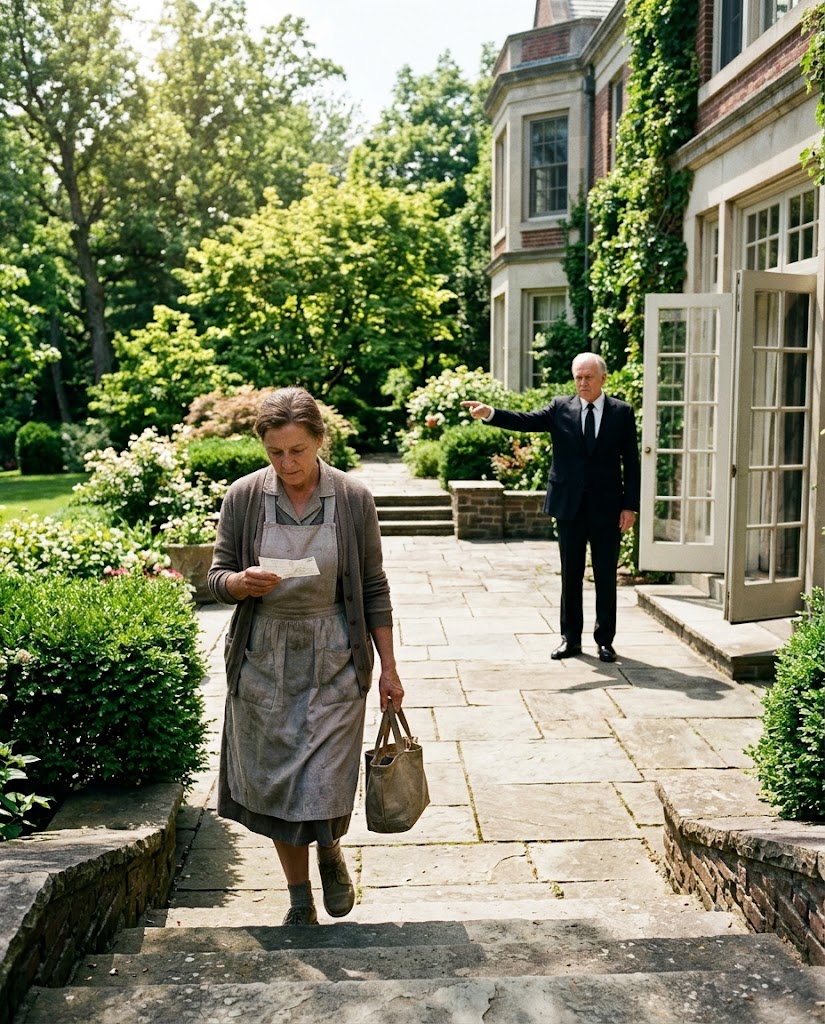
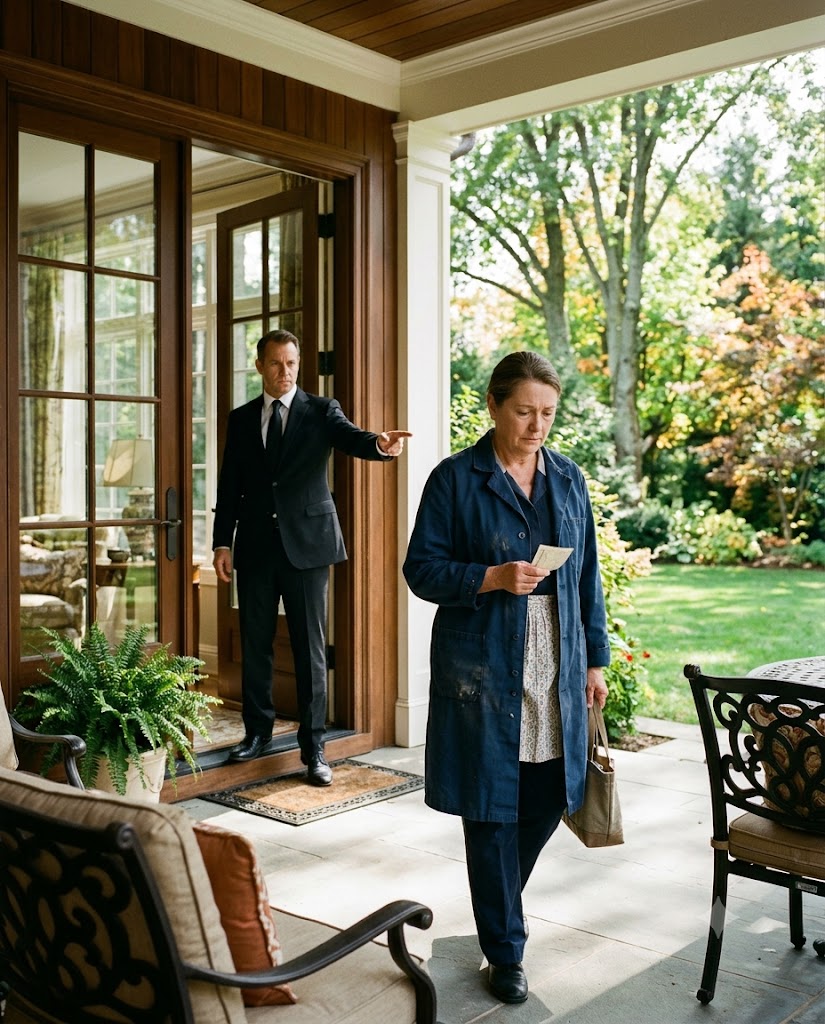
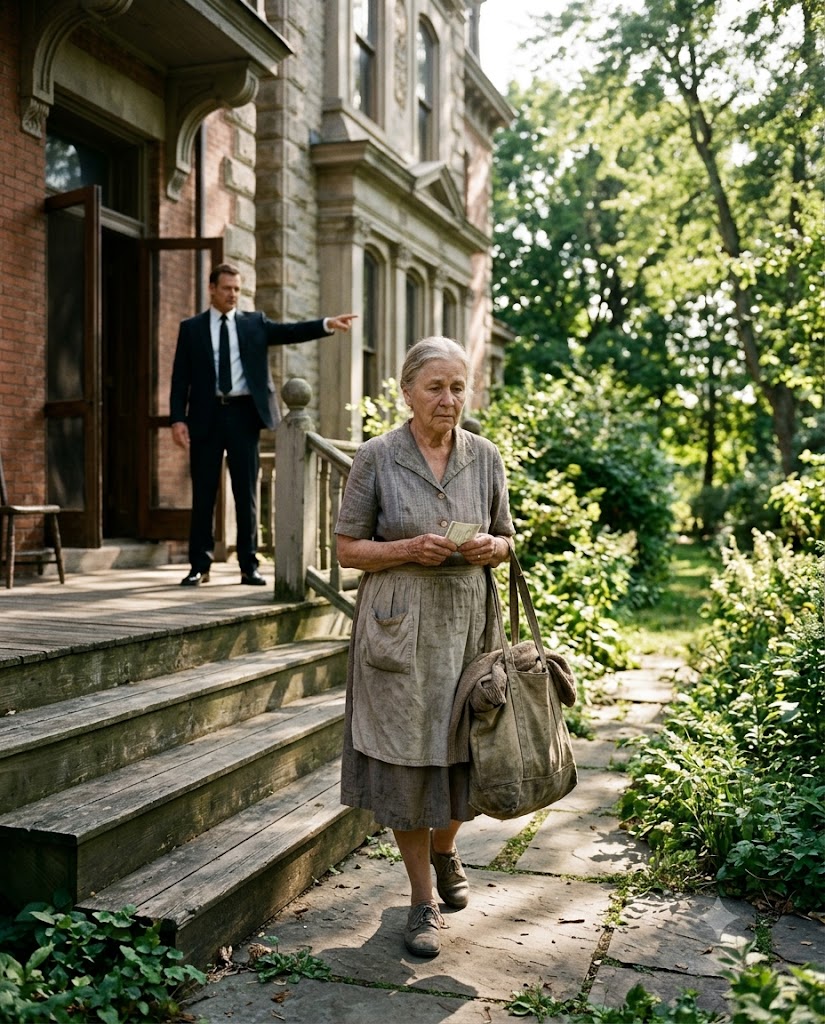
Carlton reached into his pocket and held out a check through the narrow opening in the screen.
I took it automatically.
Three hundred dollars.
I stared at the amount, thinking I must have misunderstood something.
“Mother’s gone,” Carlton said. “We won’t be needing you anymore.”
That was all.
He didn’t invite me inside. He didn’t offer me a chair or a cup of coffee. He didn’t even ask how I was doing after losing the woman I had spent more than two decades caring for.
He simply stood behind the screen and waited for me to leave.
I looked past him at his brothers, who continued talking as if I were invisible.
For twenty-six years, I had cleaned that kitchen, prepared the house for holidays, and sat with their mother when she was lonely.
Now I was being dismissed like an unwanted delivery.
“Yes, sir,” I managed to say.
I hated that those were the words that came out of my mouth.
But I had spent my entire life being polite, especially to people who had more money and power than I did.
I turned around, walked down the steps, and got into my Buick.
As I pulled away, I heard laughter coming from inside the house.
I cried for the entire eight-mile drive home.
The check sat on the passenger seat.
Three hundred dollars.
That was what twenty-six years of loyalty had apparently been worth.
At seventy-two, I could no longer work as quickly as I once had. My Social Security payment was only $784 a month. My rent was $650, and electricity, food, and medication consumed nearly everything else.
The money from Mrs. Lockridge had made the difference between getting by and falling behind.
That night, I called Alfreda.
My daughter lived in Murfreesboro with her husband, Dwayne, and their two teenage sons. She was a hardworking schoolteacher, but her family had financial problems of its own.
I told her what had happened.
She listened quietly as I described the screen door, the check, and the way Carlton had refused to let me inside.
Finally, she sighed.
“Mama, you can’t keep cleaning houses forever.”
“I know that,” I replied. “But what am I supposed to do now?”
There was a long silence.
Then she told me they couldn’t take me in.
Dwayne’s work hours had been reduced. One of the boys needed braces. Their roof needed repairs, and the boys already shared a bedroom.
“We just don’t have room right now, Mama,” she said. “I’m so sorry.”
I told her I understood.
And I did.
That was what hurt most. My daughter wasn’t trying to be cruel. She was simply struggling to keep her own family afloat.
After we hung up, I sat at my kitchen table and stared at the check.
I couldn’t bring myself to cash it.
Instead, I placed it on the refrigerator beneath a small peach-shaped magnet Mrs. Lockridge had brought me from Georgia years earlier.
Every morning, I saw the check and remembered the words Carlton had spoken.
Mother’s gone. We won’t be needing you anymore.
I began looking for another job.
I called people I had cleaned for decades earlier. Many had passed away. Others had hired professional cleaning companies.
I asked a church whether they needed someone to clean their fellowship hall. They already had a worker.
I even called a nursing home to ask about kitchen work.
The person on the phone asked my age. When I answered honestly, she said someone would call me back.
No one did.
For the first time in my life, I wondered whether I had reached an age when people could no longer see what I was capable of doing.
Then, exactly one week after Carlton dismissed me, the telephone rang again.
A woman introduced herself as Rosella Pruitt, an employee at the Maury County Register of Deeds office.
“Mrs. Whitsett,” she said, “we need you to come to the courthouse. There is something you need to see.”
I asked what it was about.
“I would rather explain it in person.”
My stomach tightened.
I had never been involved in a legal matter in my life. The idea of going to the courthouse frightened me.
When I told Alfreda about the call, she immediately became worried.
“The Register of Deeds deals with property records, Mama. Please be careful. If this involves the Lockridge family, you don’t want to get caught in the middle of anything.”
She was right about one thing.
The Lockridge family had money, influential friends, and lawyers who could probably make my life miserable if they wanted to.
I considered ignoring the call.
For two days, I stayed home and tried to convince myself that whatever Rosella wanted to show me was none of my business.
But the thought of Mrs. Lockridge’s kindness kept returning to me.
She had always told me to speak honestly, even when I was afraid.
So on Thursday morning, I put on my best dress, polished my shoes, and drove to the courthouse.
Rosella met me near the records counter.
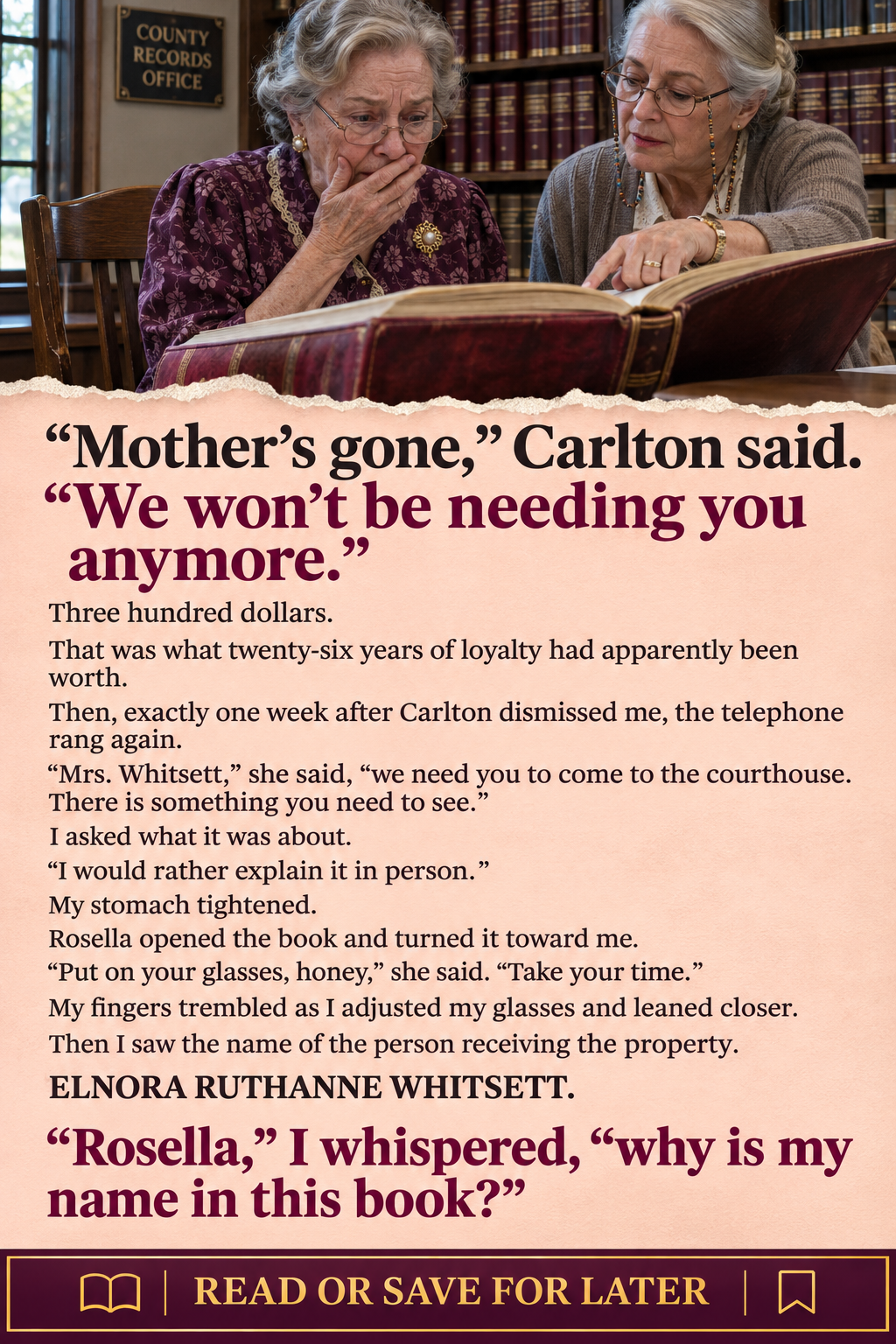
She was an older woman with silver hair and glasses hanging from a beaded chain. When she saw me, she smiled gently.
“Elnora Whitsett?”
“Yes, ma’am.”
“Thank you for coming.”
She didn’t immediately explain why she had called. Instead, she asked whether I remembered Mrs. Lockridge’s friend group.
I knew some of the women who had visited the farmhouse, but Rosella’s name was unfamiliar.
“I played bridge with Henrietta for forty years,” she explained. “Every Tuesday. Toward the end, there were only two of us left, and we played cards at her house whenever she felt up to it.”
She smiled faintly.
“She was a terrible cheater at gin rummy.”
I laughed despite myself.
“She was pretty good at checkers, too,” I said.
Rosella’s smile faded.
“Earlier this year, Henrietta asked me to promise something. She made me promise that if anything happened to her, I would contact you.”
My hands went cold.
“What did she want?”
Rosella gently took my arm.
“Come with me. There’s something you need to read for yourself.”
She led me through a door into a room lined with shelves and old records. At the center of a long wooden table sat a massive book bound in dark red leather.
A paper marker protruded from the pages.
Rosella opened the book and turned it toward me.
“Put on your glasses, honey,” she said. “Take your time.”
My fingers trembled as I adjusted my glasses and leaned closer.
At the top of the page were the words Quitclaim Deed.
Below them was a legal description of a property in Maury County, Tennessee.
Then I saw the name of the person receiving the property.
ELNORA RUTHANNE WHITSETT.
My full name.
Every letter was correct, including Ruthanne, the middle name my mother had always written as a single word.
I stared at it, certain there had to be some mistake.
“Rosella,” I whispered, “why is my name in this book?”
She pulled a chair beside me.
“Because Henrietta wanted it there.”
The deed showed that Mrs. Lockridge had legally transferred thirty-eight acres of land to me before her death.
I read the description again.
Thirty-eight acres.
The land was part of the Lockridge farm, including the pecan grove and a valuable stretch of road frontage.
I had worked on that property for twenty-six years without ever imagining I might own even a small piece of it.
“I don’t understand,” I said. “I never asked her for anything.”
“I know you didn’t.”
Rosella explained that the transfer had been prepared and recorded while Mrs. Lockridge was alive. The deed was not a vague promise or an informal note. It was an official property record.
My name was there because Henrietta had deliberately placed it there.
But that was only the beginning.
Rosella told me that Thurston had been negotiating with a development company to sell the entire Lockridge farm.
His plan was to turn the property into a subdivision called Pecan Hollow, with hundreds of houses, a clubhouse, and new roads.
He believed that once his mother died, the family would inherit the land and he could complete the sale.
The problem was that the thirty-eight acres identified in my deed were part of the proposed development.
They were no longer his to sell.
I remembered the previous morning at the farmhouse. Carlton standing behind the screen door. Thurston and Bertram drinking coffee in the kitchen. Their laughter as I walked away with a three-hundred-dollar check.
“Does Carlton know about this?” I asked.
Rosella shook her head.
“Not yet. As far as I know, Thurston doesn’t know either.”
I looked down at the deed again.
“Then why did Carlton send me away like that?”
Rosella considered the question before answering.
“I can’t tell you exactly what Carlton was thinking. But I suspect he wanted you out of the house before his brothers started asking questions about the property and the arrangements Henrietta had made.”
I thought about the check.
Three hundred dollars.
It suddenly seemed less like payment for my years of work and more like an attempt to make me disappear quietly.
Rosella reached into a folder and took out another document.
“Henrietta also left instructions that you should be given a copy of this.”
It was a statement recorded before her death. She had explained why she had transferred the land to me.
She wrote that I had been part of her life for twenty-six years, but that the decision was not meant as a reward for cleaning her house.
She wanted me to have security.
She wanted me to have something that no one could take away simply because I was getting older or because I could no longer work as hard as I once had.
Most importantly, she wanted me to understand that my life mattered beyond the service I had provided to her family.
I covered my mouth and began to cry.
For a week, I had believed I had been discarded by the only person who had made me feel appreciated.
Now I was discovering that she had thought about my future long before I knew I would need help.
Rosella waited patiently until I could speak.
“There’s one more thing,” she said.
She told me Henrietta had recorded a video shortly before her death. She had asked that it be kept until after the deed had been disclosed.
Rosella played it on a small computer at the records office.
Mrs. Lockridge appeared on the screen, sitting at her kitchen table. She wore one of her favorite blouses, and her familiar coffee cup rested in front of her.
She looked older and more fragile than I remembered, but her eyes were clear.
“If you’re watching this, Elnora,” she began, “then Rosella has kept her promise.”
I started crying again.
Henrietta explained that she had been worried about the future of the farm and the way her sons viewed the property.
She had watched Thurston grow increasingly interested in the money the land could bring him. He talked about development projects and profits, but rarely about the people who had lived and worked on the farm.
One afternoon, he had suggested that she make arrangements for me to clean his house in town.
“Mother already pays you,” he had told her. “What difference does it make?”
Mrs. Lockridge said those words had stayed with her.
They revealed how little he understood about the difference between paying someone for a service and valuing that person as a human being.
She explained that she had chosen to transfer the land to me because she trusted me to treat it with care.
She had watched me work for decades, but she had also watched me sit with her on Fridays when there was nothing to clean and no work to be done.
“You never asked me for money,” she said in the recording. “You never demanded anything. You simply showed up, week after week, and made sure I knew I wasn’t alone.”
She paused, taking a breath.
“I want you to know that this isn’t charity. I cannot give you something that should have been yours all along—the respect you deserve. But I can make sure you have a place in this world that belongs to you.”
She then explained that the deed was valid and had been properly recorded.
Finally, she looked straight into the camera.
“Elnora, if my sons make you feel that you don’t belong, remember this. You belong wherever your name is written with honesty and respect. Don’t let anyone convince you otherwise.”
The video ended.
I sat in silence, unable to speak.
For twenty-six years, I had cleaned Mrs. Lockridge’s house. I had washed her dishes, scrubbed her floors, and listened to her stories.
I had never imagined that she had been paying attention to me in quite the same way.
She had seen me.
Not just the woman who cleaned her home, but the person who had spent a lifetime working, loving, and trying to survive.
And she had made sure that the law would remember my name.
The following weeks were difficult.
Once Thurston learned about the deed, he challenged it. He argued that his mother had been elderly and might not have understood what she was signing. His lawyers questioned the circumstances of the transfer and suggested that I might have influenced her.
The accusation hurt more than I expected.
I had never asked Mrs. Lockridge for land or money. I had never even known the deed existed until Rosella called me.
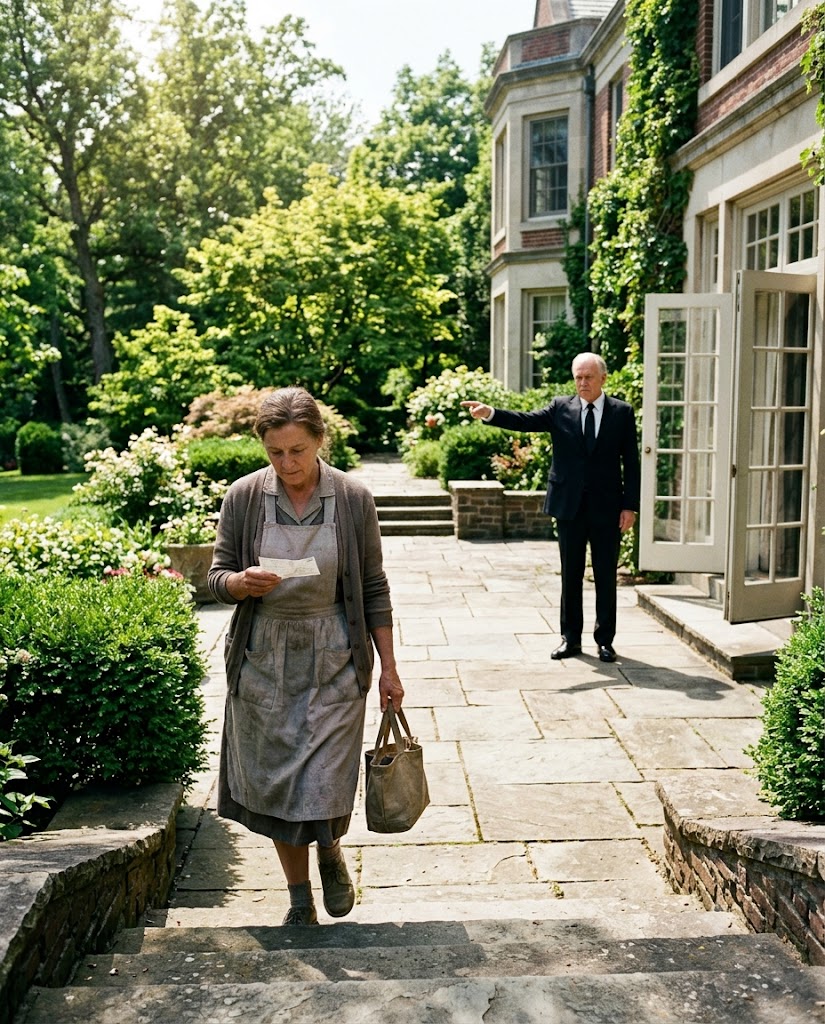
Fortunately, the records supported what Henrietta had said. The deed had been properly executed and recorded while she was alive, and the available evidence supported her ability to make the decision.
At the hearing, the court reviewed the documents and heard the arguments from both sides.
I sat quietly, my hands folded in my lap.
I was not accustomed to courtrooms. I had spent my life working in other people’s homes, not arguing with their lawyers.
But I kept thinking about Henrietta’s video.
Don’t let anyone convince you otherwise.
Eventually, the court upheld the deed and rejected the challenge.
The land legally belonged to me.
Thurston’s development deal fell apart when the company realized that it could not acquire the entire property under the terms he had proposed.
The thirty-eight acres remained mine.
I did not suddenly become a different person. I was still Elnora Whitsett, the woman who liked homemade biscuits, old-fashioned coffee, and quiet mornings at the kitchen table.
But I no longer had to wonder how I would pay my rent or whether I would be forced to keep working until my body could no longer manage it.
I had choices.
For the first time in many years, I could consider what I wanted rather than simply what I needed to do to survive.
Carlton eventually contacted me.
He apologized for the way he had treated me after his mother’s funeral. He admitted that he had handled the situation badly and should never have dismissed me at the back door with a check.
I listened, but I did not immediately forgive him.
An apology could acknowledge the hurt, but it could not erase the moment I had stood outside that screen door feeling as though twenty-six years of my life had meant nothing.
We spoke again some months later, more calmly.
I did not want revenge. I wanted peace.
I also wanted to honor the woman who had trusted me with the land.
I kept the pecan grove intact. I had no desire to cover it with houses or turn it into a business venture simply because someone else believed the property was worth more developed.
I arranged for the land to be managed responsibly and made plans to use the income to support myself in my later years.
And I kept four of Mrs. Lockridge’s china cups.
Carlton brought them to me after the family finished sorting through the farmhouse. He said his mother would have wanted me to have them.
They were white, decorated with little blue flowers, and one had a tiny chip near the handle.
I placed them in my kitchen cabinet.
Every Friday morning, I make coffee in an old percolator. I bake biscuits and sit at my table before beginning anything else.
Sometimes, I put one of those cups beside my own.
I think about Henrietta, the woman who taught me that a person’s worth is not measured by the work she performs or the money she earns.
For years, I believed that what I gave to others was all I would ever be remembered for.
But Mrs. Lockridge made sure that my name would remain in the public record long after both of us were gone.
People sometimes ask me what changed my life.
They expect me to talk about the thirty-eight acres, the court ruling, or the failed development deal.
I tell them those things mattered, of course.
But they were not the most important part.
The most important part was the moment I looked down at that deed book and saw my full name written correctly.
Elnora Ruthanne Whitsett.
Three names. Every letter in its proper place.
For most of my life, I had worked quietly in the background, cleaning other people’s homes and making their lives easier. I had rarely expected recognition, and I had learned not to ask for it.
But an elderly woman had remembered me.
She had remembered the Friday mornings, the coffee, the biscuits, the conversations, and the years I kept showing up even when my own life was difficult.
She had understood that I deserved more than a final check and a closed door.
She had made sure that the truth would be recorded where no one could quietly erase it.
And whenever I sit at my kitchen table now, I remember her words.
“The dirt will wait, Elnora. I won’t.”
So I let the dishes sit a little longer.
I let the morning sunlight fall across the table.
And I drink my coffee slowly, grateful that someone once took the time to see me for who I was.
Because in the end, what Mrs. Lockridge left me was more than land.
She left me security, dignity, and the knowledge that even a life spent quietly serving others can leave a mark that lasts.
And my name, written in that great red deed book, will remain there for generations to come.
Not because I was wealthy or powerful.
But because someone finally made sure I was seen.
More stories to explore
My Neighbor Kept Parking His Mercedes on My Lawn — But the Next Morning, He Found His Car Trapped Behind a Concrete Wall.
My Son Slapped Me at 73 Just Because I Asked Him Not to Smoke Indoors — I Called That Person, and My Son Begged Me in Panic for Forgiveness.