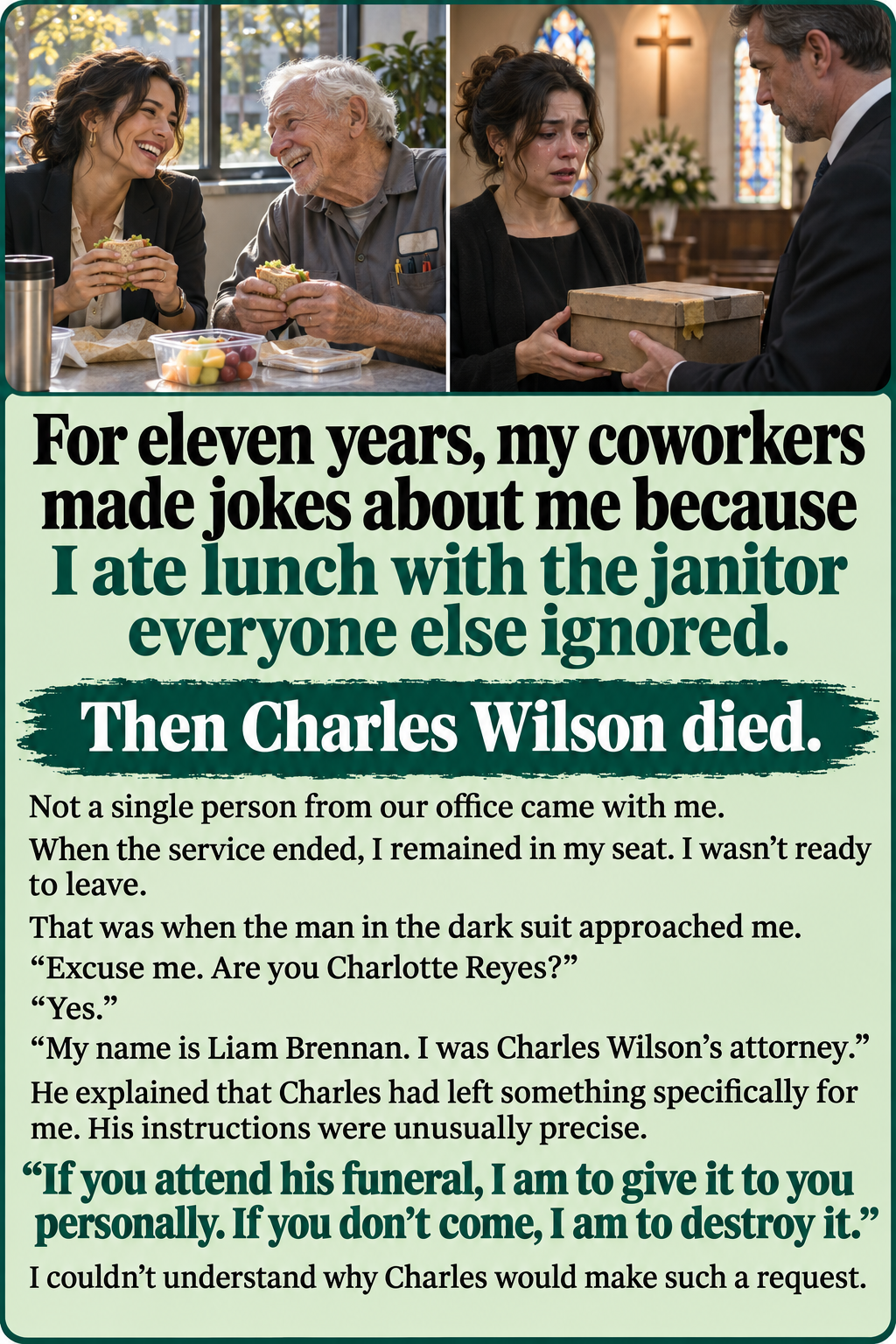
For eleven years, my coworkers made jokes about me because I ate lunch with the janitor everyone else ignored.
They called him my boyfriend. They questioned my judgment and warned me that associating with someone who cleaned offices for a living might hurt my career.
I never understood why sharing a meal with a kind old man was something to be ashamed of.
Then Charles Wilson died.

At his funeral, a lawyer approached me with an old shoebox and said, “Mr. Wilson left specific instructions. This is meant for you.”
I had no idea that the box contained the story of a friendship that had meant far more to both of us than I had ever realized.
It all began eleven years earlier, on my first day at Halvorsen & Pike.
I was twenty-eight when I moved from a small town in Kentucky to Columbus, Ohio, hoping to build a better future. I knew nobody in the city, and I was desperate to make a good impression at my new job.
By lunchtime, I was already exhausted from introductions and nervous smiles.
When I entered the break room, every table seemed occupied by groups of coworkers who knew one another well. I stood near the doorway holding my lunch bag, unsure where to sit.
That was when an older man sitting beside the window looked up.
“You can sit here if you want.”
He wore a gray maintenance uniform. His white hair was neatly combed, and his expression was warm.
His name tag read C. Wilson.
“Thank you,” I said, sitting across from him. “I’m Charlotte. I just started upstairs.”
“Charles,” he replied.
He didn’t ask me a dozen questions or make me feel awkward about being new. He simply returned to his sandwich and allowed me to eat in peace.
The next day, I returned to the same table.
This time, it wasn’t because I had nowhere else to sit. I genuinely enjoyed his company.
Before long, lunch at noon became our daily ritual. Charles brought a simple sandwich, an apple, and black coffee. I usually brought leftovers from the night before.
We talked about ordinary things: the weather, old Western novels, the broken elevator, and the strange habits of people who worked in the building.
Charles had been employed there for more than two decades. He knew everyone’s name, remembered which printers constantly malfunctioned, and could fix almost anything.
Yet most employees barely acknowledged him.
To them, he was simply the janitor who emptied their trash cans.
About two months after we met, a coworker named Derek approached me in the hallway.
“Lunch with your boyfriend again?”
I laughed and told him Charles was better company than most people in the office.
That only encouraged the jokes.
Soon, people began smirking whenever they saw me heading toward our table. Someone even taped a sign to Charles’s chair that read, “RESERVED FOR CHARLOTTE’S DATE.”
Charles removed it without saying a word. He folded the paper carefully and slipped it into his pocket.
I was furious on his behalf, but he seemed determined not to let their cruelty spoil our lunch.
The jokes continued for years.
At a Christmas party, a coworker named Megan pulled me aside and warned me that people noticed whom I associated with.
“Don’t you worry about your career? Sitting with the janitor every day isn’t exactly the impression you want to make.”
Her words bothered me more than I wanted to admit. Sometimes I wondered whether eating at my desk would be easier than enduring another round of ridicule.
But every weekday at noon, I returned to our table.
One afternoon, after another round of jokes, I asked Charles whether the comments hurt him.
He took a sip of coffee before answering.
“People are loudest when they don’t understand what quiet is worth.”
I remembered those words, although I didn’t fully understand them then.
Over the years, Charles became the person I could count on when life became difficult.
When I was promoted to senior claims analyst, he celebrated by bringing me a chocolate cupcake from a nearby gas station. It cost less than three dollars, but he had noticed the announcement on the office bulletin board and wanted me to feel proud of myself.
When I got married, he sent me a card with twenty dollars tucked inside and a handwritten wish for a happy future.
Three years later, my marriage ended.
I returned to work on Monday feeling hollow. At lunch, I sat across from Charles and barely touched my food.
He didn’t force me to explain.
He talked about a broken elevator and a raccoon he had found near the dumpsters until I finally felt ready to speak.
“My husband moved out,” I told him. “We’re getting divorced.”
Charles nodded gently.
“I thought something was wrong. You stopped wearing your wedding ring.”
I hadn’t realized anyone had noticed.
The following year, my mother died from a stroke. I returned to work three days after her funeral because I couldn’t bear sitting alone in my apartment.

That afternoon, I realized I had forgotten my lunch.
Charles looked at my empty hands, divided his sandwich in half, and pushed a piece toward me.
“Eat something, Charlotte. You’ll feel worse if you don’t.”
I tried to hold myself together, but I broke down crying in the crowded break room.
He didn’t tell me to be strong or insist that everything would be fine. He simply sat with me until I could breathe normally again.
For the next two weeks, he brought an extra sandwich every day.
He never asked for anything in return. He had helped me jump-start my car, recovered my grandmother’s ring from a sink drain, and left soup on my desk when I was sick.
He also remembered my birthday every year, always bringing the same inexpensive cupcake.
I knew his wife, Ruth, had died years earlier. He lived alone in a small house in Clintonville and tended a little garden.
But he rarely spoke about his family.
Once, I asked whether he had children.
He stared out the window for a long moment.
“I did.”
Then he changed the subject.
I respected his silence and never asked again.
I had no idea that those two words concealed a heartbreak that had shaped the rest of his life.
Then, one Monday morning in March, Charles failed to show up for work.
I assumed he was sick and would return the next day.
Tuesday passed. Then Wednesday.
On Thursday, my manager stopped beside my desk with a stack of files.
“Did you hear about the janitor? Charles, I think his name was. Apparently, he passed away over the weekend.”
She delivered the news so casually that, for a moment, I couldn’t understand what she had said.
“Charles Wilson?”
“I believe so. Anyway, can you finish that assignment by three?”
I excused myself and hurried to the restroom. I sat in a stall with my hands pressed over my mouth, struggling to breathe through the shock.
Charles had died of a heart attack on Saturday, March 8. He had worked in the building for thirty-three years.
Human Resources had announced his death in an email, but most people barely seemed to notice.
I couldn’t stop thinking about the man who had spent eleven years making sure I never had to eat lunch alone.
His funeral was held the following Saturday at a small chapel in Clintonville.
I asked several coworkers whether they planned to attend.
Everyone had an excuse.
Megan even praised me for going, speaking as though attending the funeral of someone who had been my friend was an extraordinary act of generosity.
Not a single person from our office came with me.
Inside the chapel, barely a dozen mourners sat scattered among the pews. There were a few neighbors, some elderly church friends, and a man in a dark suit near the front.
I sat toward the back and listened to the pastor speak.
Beside the casket stood a photograph of Charles as a young man. His hair was dark, his face was full, and he wore a broad smile I had rarely seen during our years together.
When the service ended, I remained in my seat. I wasn’t ready to leave.
That was when the man in the dark suit approached me.
“Excuse me. Are you Charlotte Reyes?”
“Yes.”
“My name is Liam Brennan. I was Charles Wilson’s attorney.”
I stared at him, surprised.
He explained that Charles had left something specifically for me. His instructions were unusually precise.
“If you attend his funeral, I am to give it to you personally. If you don’t come, I am to destroy it.”
I couldn’t understand why Charles would make such a request.
Liam reached beside the pew and picked up an old shoebox. Its cardboard was worn, and one corner had been repaired with yellowing tape.
“Mr. Wilson wanted you to have this.”
I accepted the box with trembling hands.
Inside were dozens of photographs.
The first showed me sitting across from Charles in the break room on my very first day. I was clutching my lunch bag, looking nervous and uncertain.
I had never known anyone had taken that picture.
Beneath it were photographs from my promotion, my birthdays, my engagement, and the painful weeks surrounding my divorce.
There was even a picture of the half sandwich Charles had shared with me after my mother’s funeral.
Then I found the photograph of the cruel sign my coworkers had taped to his chair.
He had kept it.
At the bottom of the box lay four small black notebooks secured with rubber bands.
I recognized them immediately. Charles had carried a notebook in his pocket for as long as I had known him. After lunch, he always wrote something down.
I had assumed he was recording maintenance problems.
I opened the first notebook.
The earliest entry was dated September 14, the day we met.
“New girl from Kentucky. Charlotte. Too frightened to eat. Offered her a chair.”
I turned the page.
There was another entry about me, followed by another and another.
He had been writing about our friendship for eleven years.
He recorded the day I got promoted and how I tried not to cry over his cupcake. He noted when I stopped wearing my wedding ring and waited until I was ready to tell him why.
He remembered the day I returned after my mother’s funeral and how I cried over half a sandwich.
He had even recorded the cruel comments our coworkers made. He remembered that I laughed at Derek’s jokes to avoid confrontation, but my hands shook afterward.

The final entry was dated March 7, the Friday before his death.
“Eleven years, and she’s still the best part of my day.”
I pressed the notebook against my chest and wept.
Then I discovered a folded letter tucked inside the back cover.
My name was written across the front in Charles’s familiar handwriting.
I carried the box outside and sat beneath a budding dogwood tree before opening it.
The letter began by acknowledging the jokes my coworkers had made. Charles had heard them all, but he had never considered our friendship something to be ashamed of.
He knew people assumed I was simply taking pity on a lonely old janitor.
They were wrong.
As I turned to the second page, a photograph slipped from the letter and landed in my lap.
It showed Charles standing beside a young woman wearing a graduation gown. She had dark, wavy hair and a crooked smile that looked strangely familiar.
I turned the photograph over.
In faded blue ink, he had written:
“My daughter. Grace. Ohio State, Class of 1983.”
My hands began to shake.
Charles explained in the letter that Grace had been his only child. She had dreamed of becoming a social worker and helping people who had been forgotten by the world.
Three weeks after graduating, she was killed by a drunk driver who crossed into her lane. She was only twenty-two.
Charles and Ruth never truly recovered from losing her.
When Ruth died in 1999, Charles was left alone with the memories of the family he had once expected to grow old with.
For years, his job and his daily routine had been the only things that gave his days structure.
Then, one September afternoon, he saw a frightened young woman standing in the break room, holding her lunch bag with both hands.
Me.
He wrote that I reminded him of Grace, not only because of our similar appearance but also because of the nervous smile we shared.
Seeing me that first day had brought warmth back into a life he had thought would remain empty.
He had never told me because he didn’t want me to feel responsible for replacing his daughter. He wanted our friendship to be real, without guilt or obligation.
Then I reached the final lines.
“Everyone thought I gave you a place at my table, Charlotte. The truth is, you gave me a place in the world again.”
I broke down beneath the tree.
For eleven years, Charles had helped me through some of the hardest moments of my life. All that time, he had been carrying a grief I had never understood.
A few minutes later, Liam joined me on the bench.
He told me Charles had spoken about me often while preparing his will. He had described me as one of the bravest people he had ever known.
Then Liam explained the rest of Charles’s final arrangements.
Charles had left his house to a church food pantry. His savings would fund scholarships for students pursuing social work, established in Grace’s name.
The shoebox was the only possession he had specifically left for me.
Before leaving, Liam paused.
“Charles asked me to tell you something. He said you should go back to your table and never let those people take it away from you.”
I looked down at the photographs and notebooks in my lap.
For the first time, I understood what Charles had given me.
On Monday morning, I returned to Halvorsen & Pike carrying the shoebox beneath my arm.
At noon, I walked into the familiar break room.
Derek was entertaining his usual audience. Megan stood beside the coffee machine.
When she saw me, she approached with a carefully sympathetic expression.
“Charlotte, how are you doing? I heard you went to the janitor’s funeral.”
For eleven years, I had swallowed comments like that to avoid confrontation.
Not anymore.
I walked to our table beside the window and placed the shoebox on the familiar surface.
Then I turned toward the room.
“His name was Charles,” I said. “Charles Wilson.”
The conversations around me began to fade.
I told them that Charles had worked in the building for thirty-three years. He had repaired their equipment, helped them when their cars wouldn’t start, and remembered their names even when they couldn’t be bothered to learn his.
“He knew your names, your problems, and the things you needed help with,” I continued. “But most of you never bothered to learn anything about him.”
I opened the box and laid the photographs across the table.
I showed them the picture from my first day, the cupcake from my promotion, the sandwich after my mother’s funeral, and the humiliating sign someone had placed on Charles’s chair.
Then I opened his notebooks.
I didn’t need to deliver another speech. The photographs and his handwritten memories told the story better than I ever could.
Derek lowered his eyes when he saw the sign he had once laughed about.
Megan picked up the photograph of Grace and studied her face.
“She looks so much like you,” she whispered.
“I know,” I replied.
She carefully put the photograph back.
Nobody offered a dramatic apology. I hadn’t come to demand one.
I only wanted them to understand that Charles had been a person worth knowing. He had not been an invisible employee whose kindness could be dismissed simply because of the uniform he wore.
Eventually, everyone returned to their seats.
I sat down at our table and took out the lunch I had packed that morning: a bologna and cheese sandwich with yellow mustard, wrapped in wax paper just as Charles used to wrap his.
I ate half.
Then I placed the other half in front of his empty chair.
For the first time since his death, the silence beside me felt less like abandonment and more like a reminder that our friendship had mattered.
In the months that followed, things began to change around the office.
A small brass plaque appeared above our table, honoring Charles Wilson and his thirty-three years of service.
The broken east elevator was finally repaired. When a maintenance worker told me they had discovered one of Charles’s final requests about it, I laughed through my tears.
Even near the end, he had been thinking about the people around him.
That June, a young employee named Mateo joined our department. He was twenty-three, newly graduated, and had moved to Columbus from a small town in New Mexico.
On his first day, I noticed him standing uncertainly in the break room doorway, clutching his lunch bag and searching for an empty seat.
He looked exactly as I had looked eleven years earlier.
For three months, I had left Charles’s chair untouched because it felt like the last physical connection I had to him.
Then I remembered the kindness Charles had shown me.
I stood and smiled at the young man.
“You can sit here, if you’d like.”
His face immediately relaxed.
He hurried over, introduced himself, and nearly knocked over my coffee in his nervous excitement.
I couldn’t help smiling.
Mateo began joining me for lunch every day. He talked about his family, his grandmother’s cooking, and the video games he loved.
I listened, discovering that friendship didn’t require grand gestures or extraordinary conversations.
Sometimes, it began with nothing more than offering someone a chair.
One afternoon, Derek made another joke about my newest lunch companion.
This time, I didn’t hesitate.
“He’s better company than you.”
Then I walked away without giving Derek another thought.
These days, I carry a small black notebook in my bag. After lunch, I write down a few details about the people and moments that might otherwise be forgotten.
Mateo once asked what I was recording.
I told him it was a grocery list.
Perhaps one day, I’ll explain the truth. I’ll tell him about a quiet man named Charles Wilson, who spent eleven years showing me that a person’s worth has nothing to do with their job title, their popularity, or the opinions of people who never took the time to know them.
Charles once offered me a seat when I felt like a stranger in a crowded room.
I thought I was simply accepting a kind gesture.
I never imagined that the friendship which followed would change both our lives.
He didn’t just give me a place at his table.
He taught me how to make sure that no one else would ever have to stand alone.
More stories to explore

A Stranger Paid for My Mother’s Groceries Every Thursday — When I Discovered Who He Was, I Couldn’t Stop Crying
A Boy Kept Buying One Flower Every Saturday — Until the Florist Followed Him and Discovered Why