My wife and I thought we were stopping for a quiet coffee and cake on an ordinary afternoon. Instead, we walked out of that café feeling humiliated, angry, and determined never to let another business treat us that way.
Neither of us expected the incident to turn into a story that would reach millions of people online.
My wife has several food allergies, and eating out can be difficult for her. We usually check menus beforehand, ask questions about ingredients, and avoid places where we cannot be certain that the food is safe. Sometimes, the easiest solution is for me to order something while she sits with me and enjoys the company.
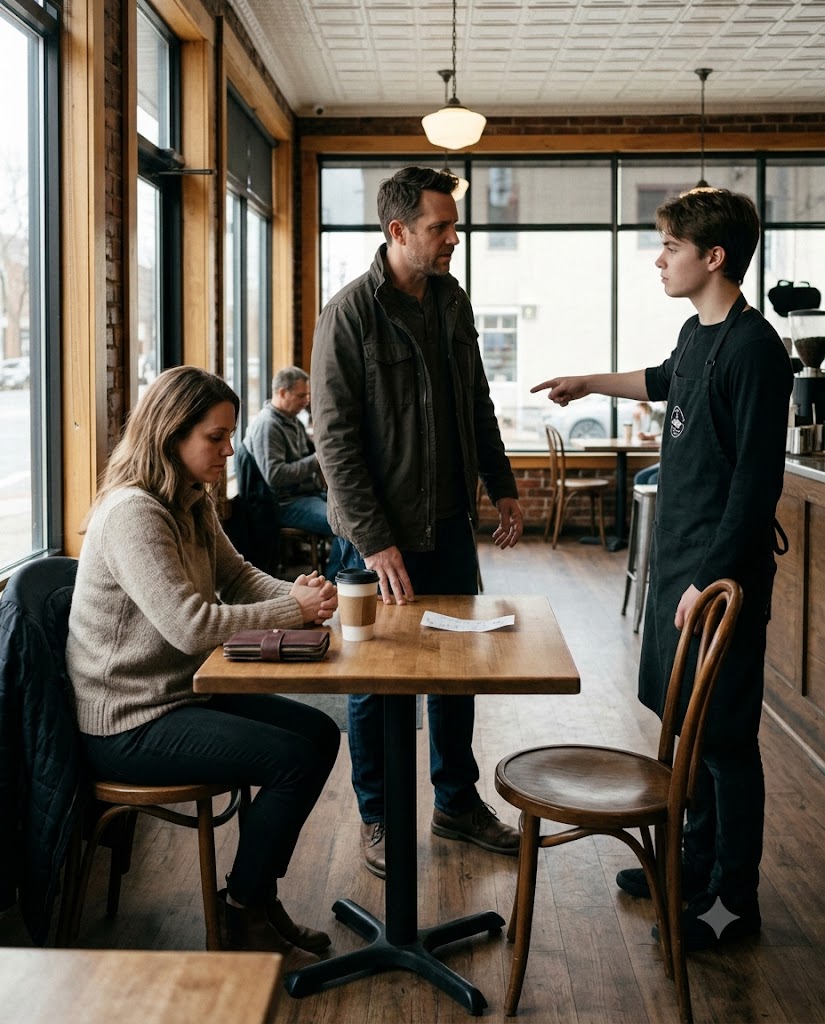
That afternoon, we found a small café nearby. It looked pleasant from the outside, and when we stepped inside, we discovered that it was practically empty. There were dozens of available seats, soft music playing in the background, and only a few staff members behind the counter.
We ordered a coffee and a slice of cake for me, paying with our joint bank account. Since my wife and I share our finances, neither of us thought anything of it.
We chose a tiny table for two near the window.
My wife settled into her seat while I took a sip of coffee. We were talking about our plans for the weekend when a server approached our table.
At first, I assumed they wanted to check whether everything was all right.
Instead, the server looked directly at my wife and said, “You can’t sit here if you’re not ordering anything. You’ll have to wait outside.”
I stared at them, convinced I had misunderstood.
“Excuse me?”
“Every customer has to order something,” the server repeated. “If she’s not eating or drinking, she can’t stay.”
I explained that my wife had food allergies and that nothing on the menu was safe for her. We weren’t occupying a crowded table, and the café was practically deserted. We had paid for my coffee and cake, and we weren’t asking for anything for free.
Surely, I thought, this was a simple misunderstanding that could be resolved with a little common sense.
The server wasn’t interested.
“It doesn’t matter,” they replied. “She needs to order something herself.”
My wife tried to explain her situation politely. She wasn’t demanding special treatment or asking the café to change its menu. She simply wanted to sit beside her husband while he enjoyed his coffee.
The server remained unmoved.
I pointed out that we had paid using our joint bank account. Technically, my wife had contributed to the purchase just as much as I had. But the server dismissed that explanation, insisting that she had to consume something personally.
I couldn’t believe what I was hearing.
There were empty tables everywhere. No customers were waiting for seats. Nobody was being inconvenienced by my wife’s presence.
Yet the server was treating her as though she had committed some terrible offense.
My wife looked at me, embarrassed. I could see that she wanted the situation to end without a scene.
“It’s fine,” she said quietly. “I’ll wait outside.”
Those words made me angrier than anything the server had said.
My wife had done nothing wrong, yet she was the one being forced to leave. She stood up, gathered her belongings, and walked toward the door while I remained at the table, trying to understand how a simple coffee stop had become so unpleasant.
Through the window, I watched her stand outside.
She wasn’t shouting or arguing. She simply waited, looking uncomfortable and hurt.
I looked down at my untouched coffee and cake. Suddenly, neither seemed worth having.
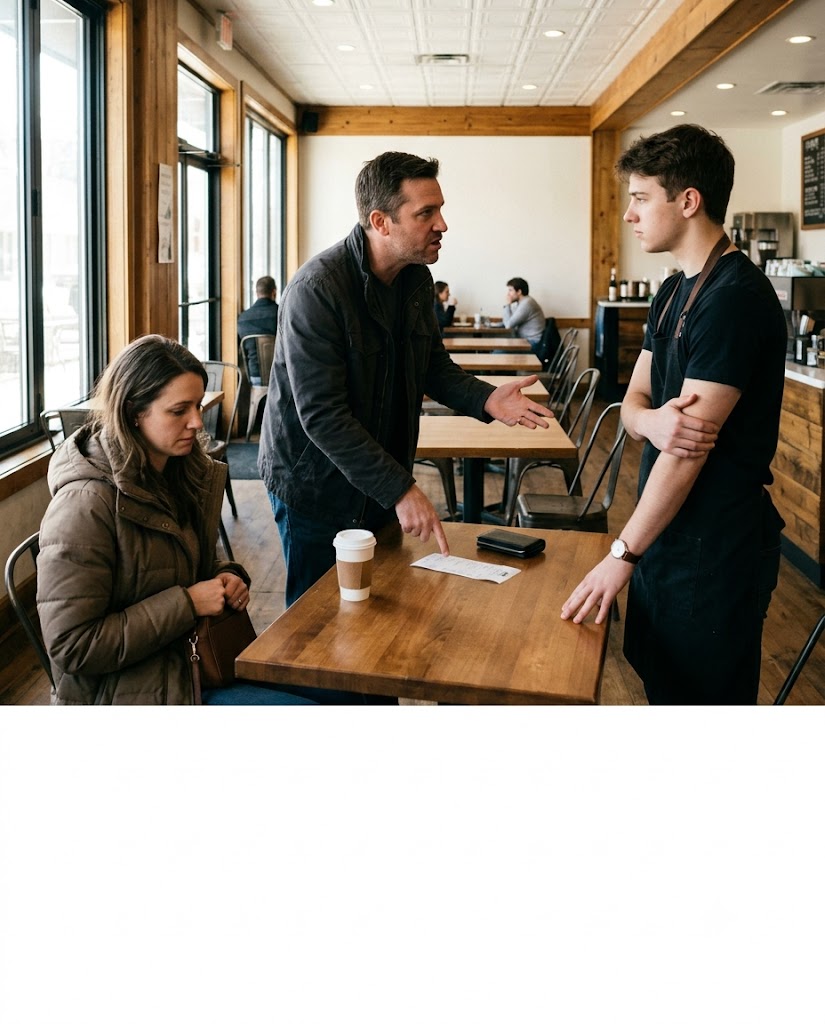
I stood up, gathered my things, and approached the counter.
“I’d like a refund,” I said.
The response was just as disappointing as everything that had happened before.
They refused.
I tried explaining that I hadn’t even finished my coffee and that we were leaving because their staff had forced my wife out. I wasn’t asking for anything unreasonable. I wanted my money back for an experience that had become completely unacceptable.
But the staff wouldn’t budge.
I left the café without finishing my drink.
Outside, my wife tried to reassure me.
“Let’s just forget about it,” she said. “It’s not worth ruining the rest of our day.”
I understood why she wanted to move on. Nobody enjoys being humiliated in public, and neither of us wanted to spend the afternoon arguing over a cup of coffee.
But I couldn’t shake the feeling that if we simply walked away, the café would continue treating other people the same way.
What if the next customer had a medical condition that prevented them from ordering anything? What if someone needed to accompany a friend or family member who had dietary restrictions? Would they also be told to stand outside while everyone else enjoyed their visit?
The problem wasn’t that the café required customers to purchase something. Businesses can establish reasonable policies. The problem was how the policy had been applied, how my wife had been treated, and how the staff had refused to resolve the situation afterward.
That evening, I decided to share what had happened on Reddit.
I described the café, explained my wife’s allergies, and detailed how a server had insisted that she leave because she wasn’t consuming anything herself. I also mentioned that we had paid from our joint bank account, that the café had been almost empty, and that the staff had refused to refund me when I left.
I wasn’t expecting much.
Perhaps a few people would sympathize. Maybe someone would suggest that I should have handled the situation differently.
Instead, the post began attracting attention.
Comments poured in. People debated whether the café’s policy was reasonable, whether the server had acted appropriately, and whether a business should be more accommodating when a customer has legitimate dietary restrictions.
Before long, the post had surpassed one million views.
I was surprised by how strongly people reacted. Many understood that a business could require purchases without humiliating someone who was accompanying a paying customer. Others pointed out that the café’s behavior had turned an ordinary transaction into an unnecessarily hostile experience.
Then something unexpected happened.
Someone who appeared to be connected to the café contacted me privately.
I assumed they might want to apologize or ask for more information so they could investigate what had happened.
I was wrong.
The messages were confrontational. Rather than expressing concern about my wife’s experience, the person demanded the exact date and time of our visit. They also hinted that they had reviewed the security footage and suggested that they might use screenshots of our faces or reveal our identities online.
The tone was unsettling.
We lived nearby, and the idea that someone connected to the café might try to identify or expose us simply because we had described our experience made me uncomfortable.
I refused to provide the requested details.
What made the situation even stranger was that the person later denied being the owner or manager, claiming instead to be an ordinary customer.
I couldn’t understand why a random customer would have access to security footage, demand precise details about our visit, and threaten to expose our identities.
Meanwhile, I noticed that some of the negative reviews appearing on Google Maps seemed to disappear. I couldn’t prove who was responsible or exactly how it was happening, but the timing was suspicious enough to raise questions.
The more I watched the situation unfold, the more convinced I became that staying silent would accomplish nothing.
I didn’t want to harass anyone or encourage people to target the café’s staff. I simply wanted the facts to remain visible so that others could make their own decisions.
I stood by my original account.
I explained what had happened, why my wife hadn’t ordered anything, and how the café had responded when we tried to resolve the situation. I made it clear that I wasn’t demanding special treatment. I had expected basic courtesy, a little understanding, and a reasonable conversation.
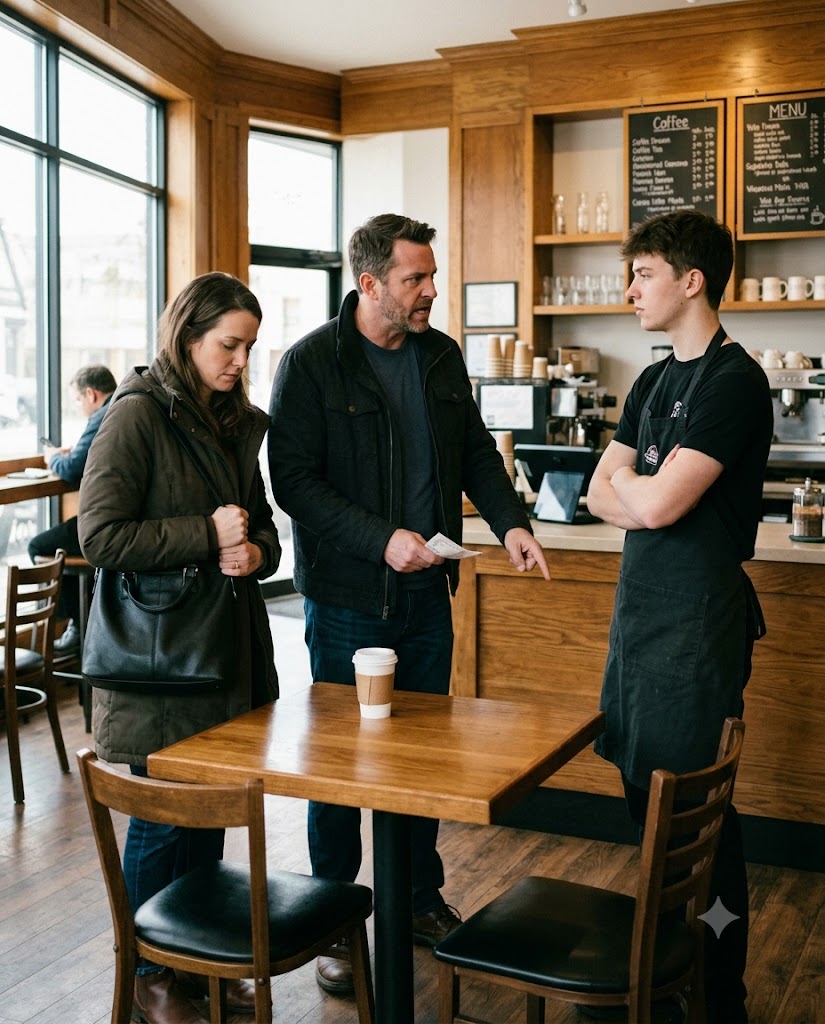
Instead, my wife had been told to leave an almost empty café, and I had been refused a refund after deciding to leave with her.
That was the experience I wanted people to understand.
I never received the apology I had initially hoped for. I also never got my money back.
But the incident taught me something important about standing up for someone you love.
My wife had tried to minimize what happened because she didn’t want to make a scene. She had been embarrassed enough without having to defend herself against a stranger who refused to listen.
I couldn’t change the way the server had treated her, but I could refuse to pretend it was acceptable.
Our afternoon coffee had turned into a public dispute that neither of us had anticipated. Yet the most important part of the story was never the number of views or the arguments in the comments.
It was the moment I watched my wife walk outside while I sat alone at a table, realizing that someone had made her feel unwelcome for a reason she couldn’t control.
I would never want another person to experience that kind of humiliation.
And if a business chooses to respond to a customer’s honest criticism with hostility instead of accountability, it shouldn’t be surprised when that customer decides to tell the truth about what happened.
I went to that café expecting coffee and cake.
I left with a lesson I won’t forget: treating people with dignity costs nothing, but refusing to do so can cost a business far more than the price of one unfinished drink.
More stories to explore

My Neighbor Kept Parking His Mercedes on My Lawn — But the Next Morning, He Found His Car Trapped Behind a Concrete Wall.
They Wouldn’t Let Me Inside the House I’d Cleaned for 26 Years — A Week Later, I Discovered Their Mother Had Put My Name on a Deed