That Tuesday afternoon, the pediatric orthopedic clinic was running as usual. I had been working as an orthopedic technician for 12 years, removing thousands of casts and treating countless children who were frightened of medical procedures.
My job was relatively simple: remove casts, prepare patients for X-rays, and help doctors monitor the recovery of children with broken bones.
But sometimes, an appointment that seemed completely ordinary could change a child’s life forever.

My next patient that day was Lily, a six-year-old girl who had suffered a spiral fracture of her tibia. Six weeks earlier, her leg had been placed in a pink fiberglass cast extending from her thigh all the way down to her ankle.
The moment Lily walked into the examination room, I noticed something unusual.
She was wearing a faded yellow T-shirt. She quietly climbed onto the examination table, sat down, and folded her little hands tightly together. Normally, children ask all kinds of questions before having their casts removed. They want to know whether the saw hurts, whether they can keep the cast, or whether they’ll be able to walk immediately afterward.
But Lily didn’t ask a single question.
The man accompanying her was named David. According to the medical records, he was listed as her guardian. He didn’t comfort or reassure the little girl. Instead, he kept checking his watch impatiently.
I smiled at Lily.
“Hello there! I’m Marcus. Today, I’m going to help you get rid of that giant pink cast!”
She kept her eyes lowered.
David immediately interrupted.
“She doesn’t need to talk. Just take it off.”
I tried explaining that the cast-removal saw only produced vibrations to cut through the fiberglass. It didn’t work like an ordinary saw, and when used correctly, it wouldn’t injure the skin.
But David seemed increasingly impatient.
“I said she’s fine. Just do your job.”
I didn’t argue. As I gently placed my hand near Lily’s knee to stabilize the cast, she suddenly jerked backward. Her entire little body curled inward as though someone had threatened her.
That wasn’t the usual reaction of a child who was simply afraid of having a cast removed.
I looked into Lily’s eyes and spoke softly.
“It’s okay. I won’t hurt you.”
David stepped forward again and kicked the leg of my chair.
“Stop talking to her. Just hurry up!”
His voice was so loud that a nurse in the hallway turned to look.
I checked Lily’s medical records once more. Her injury had been documented as an accident at a playground. There were no witnesses, and no second caregiver had accompanied her to the clinic.
Those details weren’t enough to prove anything, but they made it impossible for me to ignore my growing uneasiness.
I switched on the cast saw and began removing the fiberglass.
Lily squeezed her eyes shut. Tears quietly rolled down both cheeks, but she didn’t make a sound.
I gently reassured her.
“You’re doing great. We’re almost finished.”
As the saw approached the area where her bone had been fractured, something unexpected happened.
The blade suddenly struck something extremely hard.
The saw vibrated violently in my hand.
I immediately released the trigger.
It wasn’t ordinary fiberglass. It didn’t feel like a seam in the cast, either.
I set the saw aside, took a cast spreader, and carefully widened the opening.
The moment the cast began to separate, an unpleasant odor escaped. It smelled like rusted metal, old blood, and something that had been trapped beneath the padding for weeks.
I switched on my examination light and looked inside.
My heart nearly stopped.
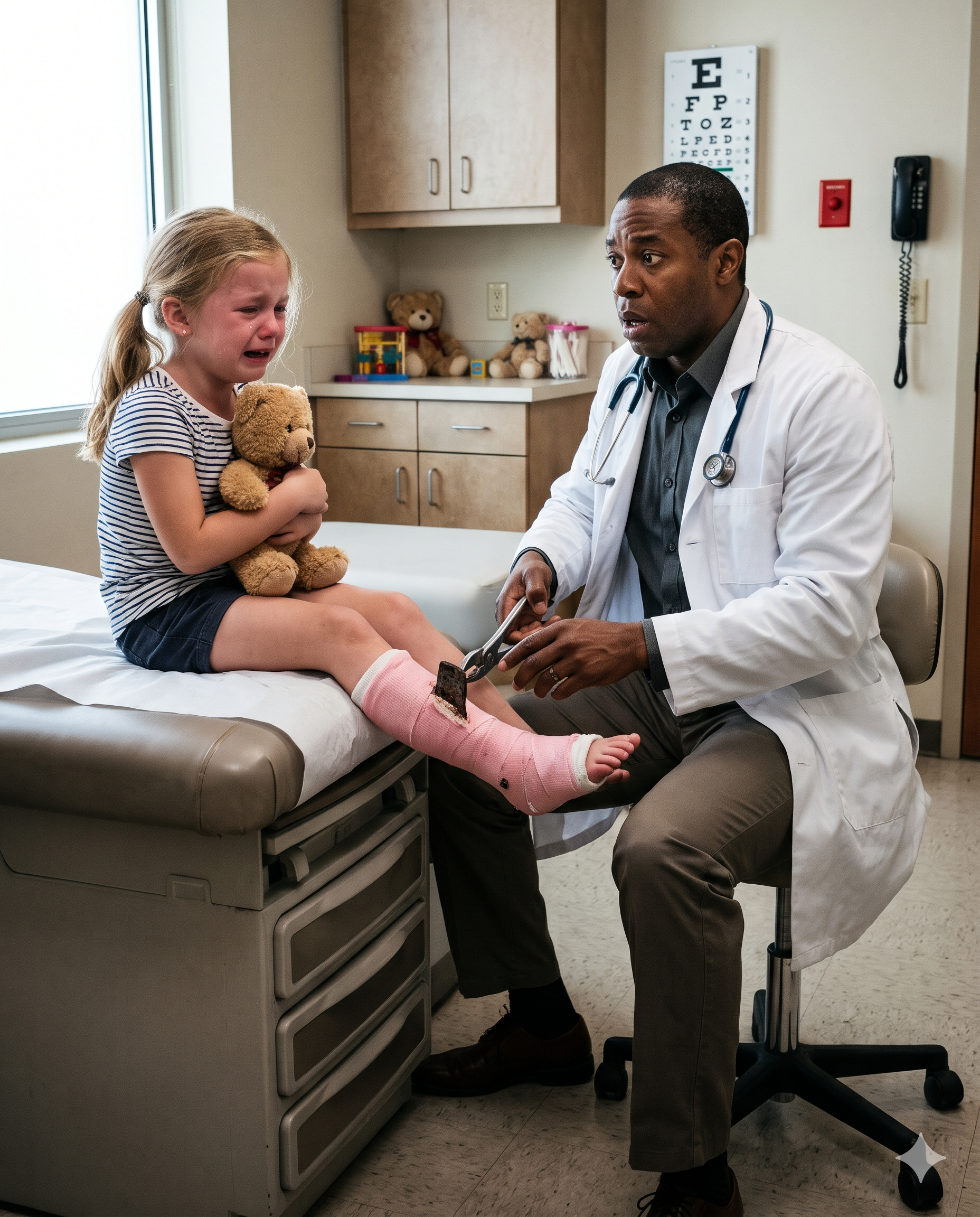
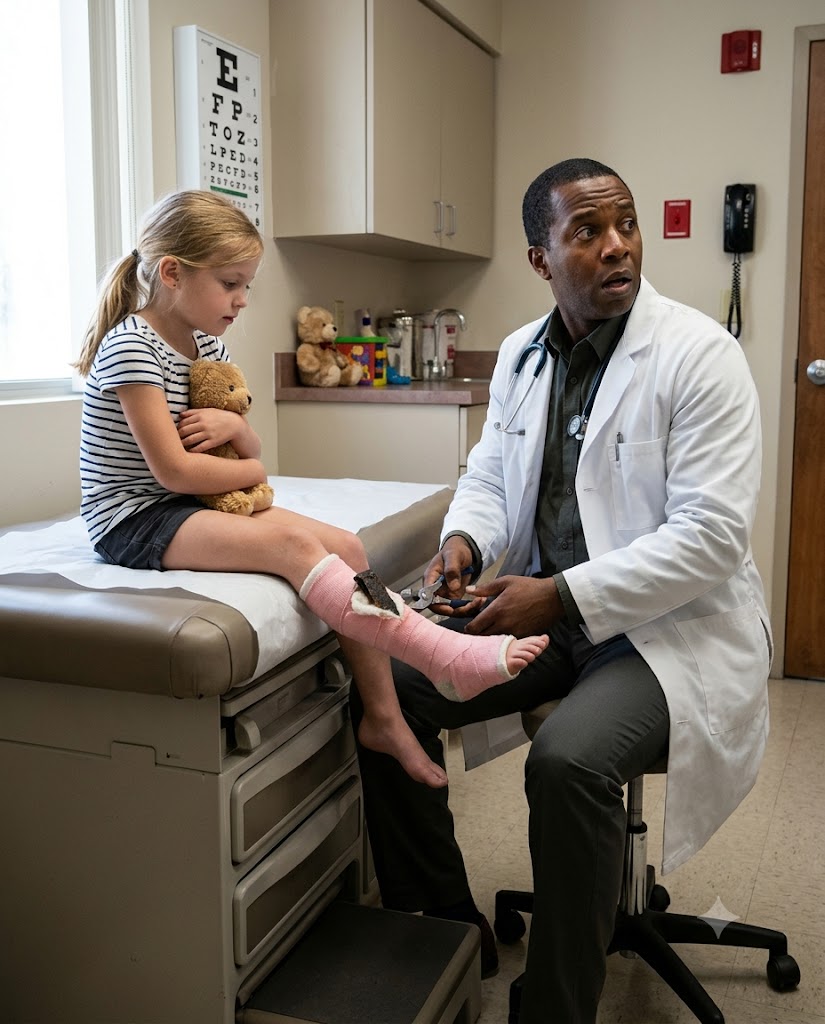
Pressed against the bruised skin of Lily’s leg was a rusted piece of industrial metal with a sharp edge. It had been wrapped in a bloodstained piece of plastic.
It wasn’t simply lying loose inside the cast.
Someone had deliberately positioned it against the exact area where every movement of Lily’s leg would cause the metal to press against her healing bone.
Behind the metal fragment was a tiny piece of paper, folded tightly.
Before I could read it, I noticed that David had gone pale.
His eyes were fixed on the opening in the cast.
“What’s going on?” he asked.
His voice suddenly sounded cautious.
“I’m just checking something,” I replied, trying to remain calm.
I didn’t want David to realize what I had discovered. Beneath my examination table was an emergency alert button reserved for medical staff.
I quietly pressed it.
A small red light illuminated, confirming that the signal had reached the nurses’ station.
A few seconds later, Nurse Ellen entered the room with two security officers.
I leaned toward her and whispered:
“There’s something inside the cast. It could be evidence. Don’t let anyone touch it.”
Ellen immediately understood how serious the situation was.
David began reacting aggressively.
“This is just a routine cast removal! What are you doing? Why are you treating me like a criminal?”
One of the security officers instructed him to step back.
But David refused to move. He even reached inside his jacket, making everyone immediately alert.
When he was ordered to show his hands, he pulled out his phone instead.
Security instructed him to hand over the device so that nothing potentially related to the incident could be deleted.
At that moment, David turned toward Lily and shouted:
“She’s lying! That little girl makes things up!”
Lily immediately curled inward, wrapped her arms around her chest, and lowered her head.
I couldn’t stand there and watch any longer. I stepped between him and the little girl.
“That’s enough!”
The two security officers escorted David into the hallway. He continued shouting, but eventually, the examination room door closed behind him.
For the first time since entering the clinic, Lily no longer had to look at the man standing beside her.
The attending physician and a hospital social worker were quickly called in. Everything inside the cast was photographed, documented, and carefully preserved before anything was removed.
The rusted metal fragment was taken out first. Then the doctor gently removed the padding.
What we saw underneath broke our hearts.
There were dark bruises, pressure injuries, and fresh skin irritation exactly where the metal fragment had been pressing against her leg.
Lily still wasn’t crying. She simply watched everyone in the room, as though trying to figure out whether anyone would finally believe her.
Finally, the doctor unfolded the tiny piece of paper.
Written in crooked purple crayon were just five simple words:
“Tell my mom he did it.”
The entire room fell silent.
I felt a painful tightness in my chest. A six-year-old child had hidden the only plea for help she thought might make someone listen inside her own cast.
The social worker continued reviewing Lily’s medical records. She discovered that her mother’s emergency contact information had been crossed out with black ink.
Her mother’s name was Rachel.
Fortunately, the hospital’s electronic records system still contained contact information from previous appointments. The social worker quickly found an old phone number and called Rachel.
About 20 minutes later, she called back.
“She answered. She’s on her way.”
Lily lifted her head and asked for the first time:
“Is my mommy coming?”
Nurse Ellen smiled.
“Yes, sweetheart. She’s coming.”
Less than half an hour later, a woman soaked from the rain rushed into the clinic.
“Where is my daughter? Where is Lily?”
It was Rachel.
When she entered the room and saw her little girl lying on the examination table, Lily lifted her head and slowly reached out both arms.
“Mommy…”
Rachel immediately knelt beside her. She didn’t rush to grab her daughter. Instead, she gently waited, allowing Lily to decide when she was ready to be held.
Only when Lily leaned toward her did Rachel wrap her arms around her.
Both of them began to cry.
Afterward, the social worker explained that David was not Lily’s biological father. He had once been Rachel’s partner and had been given temporary guardianship when Rachel went through a difficult period after losing stable housing.
The original arrangement was only supposed to ensure that Lily received proper care for a short time. But things had gradually gone terribly wrong.
David had deliberately removed Rachel’s contact information from the paperwork, preventing her from receiving notifications about medical appointments and her daughter’s condition.
David’s phone, the metal fragment, the bloodstained plastic, the cast, and Lily’s handwritten message were all preserved as evidence. Local police took over the case and began investigating.
Meanwhile, Lily was kept in the hospital overnight so doctors could examine the injuries to her leg and make sure her bone was healing properly. Rachel stayed beside her the entire time, refusing to leave even for a minute.
A few weeks later, I learned that the investigation had expanded. Medical experts confirmed that the metal fragment could not have accidentally ended up inside the cast. It had been deliberately placed where every movement would cause Lily pain.
The evidence collected from David’s phone, the medical examination, and statements from hospital staff became important parts of the investigation.
After hearings concerning guardianship, Rachel was granted full custody of Lily again, while child protection authorities continued monitoring the situation and handling the case.
A few months later, the social worker brought me an envelope.
Inside was a thank-you card drawn by Lily herself.
On the front, she had drawn a little girl standing beside someone wearing a blue medical coat. Above them was a bright yellow sun.
Inside were a few lines written in purple crayon:
“Thank you for believing me. My leg doesn’t hurt anymore. Mommy says I’m safe now.”
I read those words over and over again.
Then I carefully placed the card in my personal drawer. It remains there to this day.
Many people think an orthopedic technician’s job is simply to help patients heal broken bones.
But sometimes, what we do is far more important than that.
We don’t just remove casts. We also have to observe, listen, and recognize when a child is trying to ask for help in the only way they know how.
I still remember the moment the saw struck something hard inside that pink cast.
One unusual vibration.
One minute spent stopping to investigate.
If I had ignored that feeling, if I had rushed because the clinic was busy, or if I had dismissed the fear in Lily’s eyes, that tiny piece of paper might never have been discovered.
Five words written in purple crayon changed everything.
“Tell my mom he did it.”
Sometimes children don’t know how to express their pain. They may stay silent, become frightened, or try to ask for help through the smallest actions.
And sometimes, the truth is hidden somewhere no one would ever think to look — waiting for someone who cares enough to stop and find it.
More stories to explore
Family Celebrated When Their Missing Son Returned After 3 Years — Until Police Discovered Who He Really Was
Just Minutes Before My Wedding, My 5-Year-Old Daughter Whispered, “Mommy, Look Inside My Bunny” — I Grabbed Her Hand and Ran Away From My Own Wedding.