I was 28 years old when a doctor looked me straight in the eyes and said three words I had never imagined hearing at that age.
“You have cancer.”
I still remember that examination room. The ticking wall clock, the strong smell of antiseptic, and my hands turning ice-cold as I struggled to process what the doctor had just told me.
I had always thought I had my whole life ahead of me. I wanted to travel, get married, have children, and build a happy family. But in just a few minutes, it felt as though all those plans had disappeared.
The next fourteen months became the hardest period of my life.
I endured endless rounds of chemotherapy. My hair fell out in clumps whenever I washed it. Some nights, I had to sleep beside the bathroom because the nausea was so severe that I couldn’t even make it back to my bedroom. On my worst days, I barely had enough strength to walk from my bed to the mailbox outside.
I had always believed my family would be my greatest source of support.
But I was wrong.
Whenever I felt unbearably lonely, I would call my mother. I didn’t need her to solve my problems or say anything particularly comforting. I just wanted to hear her familiar voice, the same voice that had soothed me whenever I was sick as a little girl.
But her response was usually the same.
“Sweetheart, I have to get up early tomorrow. We’ll talk later, okay?”
At first, I kept trying again the next day.
Then I reduced my calls to once every few days.
Eventually, I stopped calling altogether.
My older sister, Paige, had two young children and constantly said her life was too busy. My younger brother, Dean, always used work as an excuse for not visiting. All three of them knew I was going through chemotherapy, but none seemed particularly interested in finding out what I was actually experiencing.
I didn’t want to become a burden.
So I learned to get through everything on my own.
I drove myself to the hospital whenever I had enough strength. I bought my own medication, prepared simple meals, and wiped away my tears whenever another round of treatment ended.
Some nights, I lay staring at the ceiling, wondering whether anyone in my family would even notice if I never woke up again.
Then, finally, the day I had been waiting for arrived.
After a routine examination, my oncologist walked into the room with a smile I had been longing to see for more than a year.
“Ma’am, we can’t find any evidence of disease. Your results show no current signs of cancer.”
I froze.
“You mean… I’m cancer-free?”
He nodded.
I burst into tears right there.
I couldn’t believe I had actually made it through everything. The painful nights, the chemotherapy sessions that made me feel like I couldn’t take another breath, the days spent facing my fears alone… It was finally coming to an end.
The first people I wanted to share the good news with were my family.
I called my mother.
“Mom! I have wonderful news. The doctor says there’s no evidence of cancer anymore!”
She screamed with excitement. She promised to bring flowers to the hospital on the day I rang the victory bell.
Paige promised to record the moment so the whole family could keep the video forever.
Dean even offered to drive me home after the ceremony.
“Wouldn’t miss it,” he said.
For the first time in months, I felt like I actually had a family standing behind me.
I started preparing for that special day.
I bought a beautiful dress, the first thing I had purchased for myself in more than a year, after spending so long thinking only about medication and hospital appointments. I spent time doing my hair, choosing the right shoes, and imagining my mother hugging me while Paige recorded the moment and Dean stood nearby applauding.
I knew it was only a small ceremony.
But to me, it meant more than any birthday party ever could.
It was the day I would finally celebrate winning the longest battle of my life.
That morning, I arrived at the hospital early.
At 11:45 a.m., I was standing beside the victory bell, repeatedly smoothing my dress and checking my phone.
Nobody had arrived.
I assumed they were probably on their way.
Then my phone buzzed.
The first message was from my mother.
“Paige needs help with the kids. I’m sorry, sweetheart. We’ll see each other later.”
I read the message over and over.
Immediately afterward, Paige texted:
“It’s just a bell, Nora. Don’t make such a big deal out of it.”
Dean sent a short message, too.
“Work is crazy right now. Don’t make me feel guilty.”
I stood motionless in the hospital hallway.
I tried not to cry. I told myself that perhaps they were genuinely busy, perhaps they would arrive late, perhaps there was still some reasonable explanation.
But then I called my mother.
“You promised me.”
She sighed.
“But you’re healthy now, aren’t you? Can’t you just be happy about that?”
I fell silent.
Behind her voice, I heard Paige laughing. They were together. Perhaps the whole family was spending time with one another, everyone except me.
I looked at the bell in front of me.
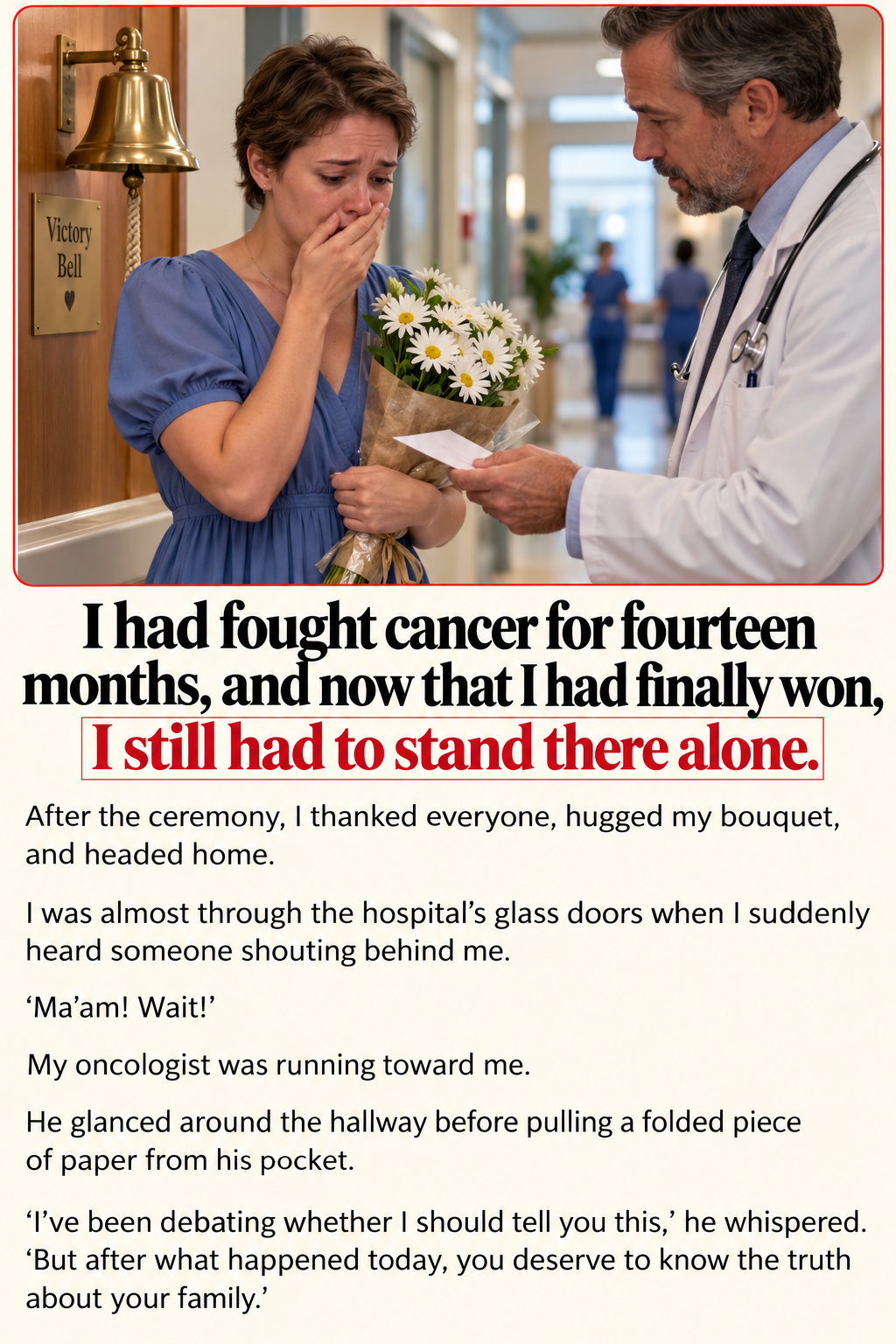
I had fought cancer for fourteen months, and now that I had finally won, I still had to stand there alone.
A part of me wanted to walk away immediately.
But then I thought about everything I had endured.
I couldn’t let their indifference steal this moment from me.
I had survived. I deserved to celebrate.
A nurse approached me. She looked around and gently asked:
“Is nobody coming with you?”
I forced a smile and shook my head.
She didn’t say anything else. She simply placed a hand on my shoulder before walking away.
Ten minutes later, while I was still standing beside the bell, something unexpected happened.
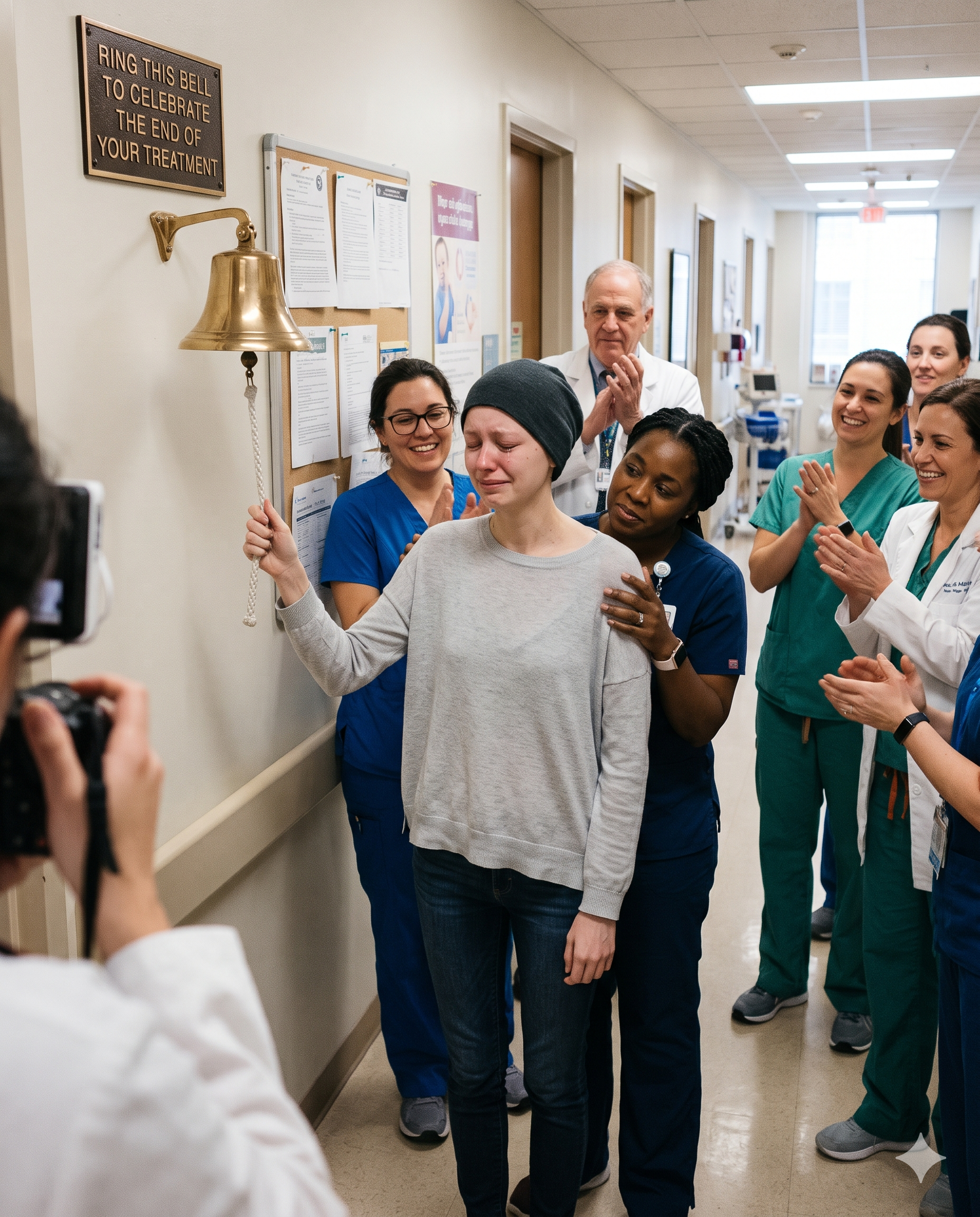
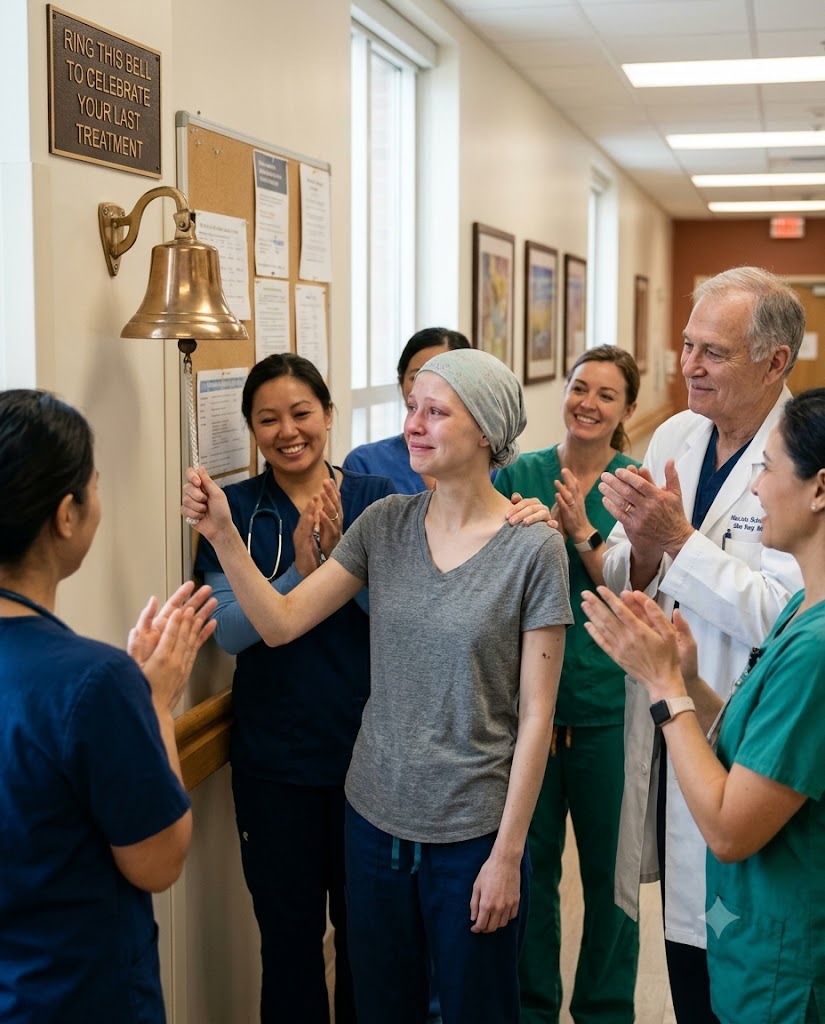
Six doctors and nurses appeared one after another.
They gathered in a small circle around me. One of them was carrying a bouquet of white daisies from the hospital gift shop.
My oncologist stepped forward.
“Nora, you don’t have to ring this bell alone today.”
I looked at them, unable to speak.
He handed me the flowers.
“We’ve watched you fight throughout this entire journey. We know what you’ve been through. And today, all of us want to be here for you.”
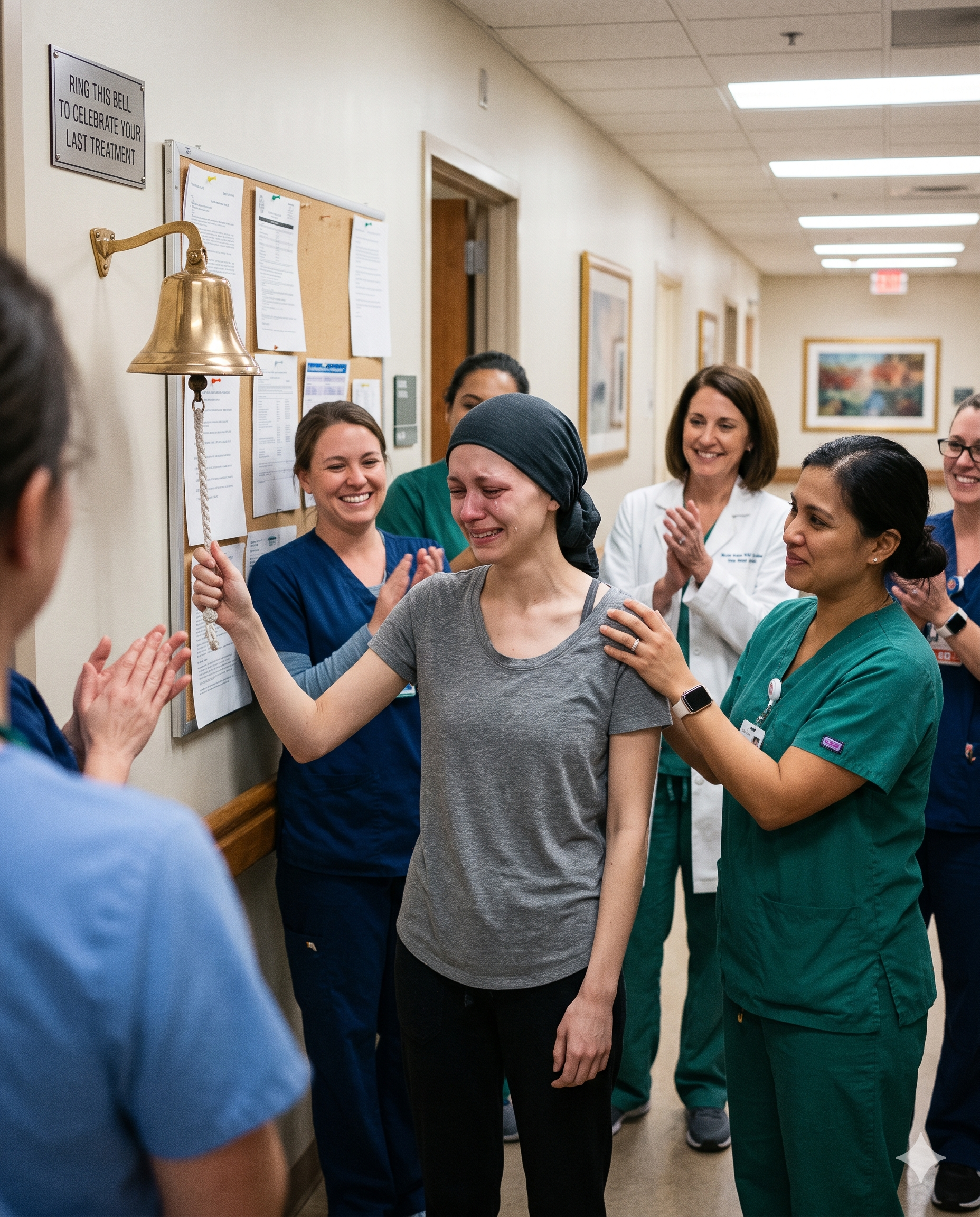
I gripped the bell rope with both hands.
I pulled hard.
Ding.
Ding.
Ding.
The sound echoed through the hallway.
Everyone applauded. A few nurses smiled, and my doctor stood beside me, visibly moved.
I burst into uncontrollable tears.
But this time, they weren’t tears of despair.
They were the tears of someone who had finally won her life back.
After the ceremony, I thanked everyone, hugged my bouquet, and headed home.
I didn’t want to trouble anyone any further.
I was almost through the hospital’s glass doors when I suddenly heard someone shouting behind me.
“Ma’am! Wait!”
I turned around.
My oncologist was running toward me. His white coat had slipped off one shoulder, and he was breathing heavily as though he had just sprinted from the other end of the hallway.
My smile immediately disappeared.
“Is something wrong with my test results?”
“No. Your results are perfectly fine.”
He glanced around the hallway before pulling a folded piece of paper from his pocket.
“I’ve been debating whether I should tell you this,” he whispered. “But after what happened today, you deserve to know the truth about your family.”
I stared at the paper in his hand.
“What is it, Doctor?”
He handed it to me. His hand was trembling slightly.
“Just read it.”
I slowly unfolded the paper.
It was a printed email, and at the bottom was my mother’s signature.
I recognized her handwriting immediately.
But as I read the first few lines, a chill ran through my entire body.
The email had been sent to my doctor about three months earlier, during a visit my mother had made to the hospital without telling me.
It read:
“We would like to know whether Nora actually needs her family to be involved throughout her treatment. She has always demanded attention, and we cannot keep putting our own lives on hold for her. If her condition becomes serious, please do not contact us unless it is absolutely necessary.”
I read it again.
Then a third time.
I couldn’t believe those were the words my own mother had written.
“What is this?” I looked up at the doctor.
He remained silent for a few seconds before explaining.
“About three months ago, your mother, sister, and brother came to speak with our patient support department. They wanted to know about your condition and what responsibilities they might have if you became unable to care for yourself.”
I tightened my grip on the paper.
“They came here?”
“Yes. But they didn’t come to visit you. They wanted us to confirm that you could take responsibility for your own treatment and daily needs.”
My throat tightened.
The doctor continued.
“I didn’t want to tell you because this was a private matter between you and your family. But today, when I saw you standing alone beside that bell, I thought you deserved to know that their absence wasn’t simply because they were busy.”
I lowered my eyes to the paper.
Beneath my mother’s email was another note, sent by Paige.
I read every word.
“We think it’s best for Nora to learn how to be independent. She’s become too dependent on everyone since getting sick. If we keep giving in to her, she’ll never learn to move forward on her own.”
I let out a laugh.
A dry, hollow laugh that barely made a sound.
Independent?
I had driven myself to the hospital for more than a year. I had endured the pain on my own, survived countless sleepless nights, and wiped away my tears when nobody else was around.
I had never asked them to abandon their lives for me.
I had only wanted them to show up once.
Just once.
“Why are you showing me this, Doctor?”
He looked at me with deep compassion.
“Because you need to understand that you did nothing wrong, Nora. You weren’t asking for too much. And you don’t need to feel guilty for wanting your family to love you.”
I didn’t answer.
I simply held the bouquet of daisies tightly against my chest.
On the drive home, his words kept replaying in my mind.
I remembered all the times I had called my mother, the unanswered messages, and the holidays I had spent alone in the hospital.
I had blamed myself so many times.
Maybe I was too sensitive. Maybe I had made everyone tired. Maybe if I had been stronger, they wouldn’t have had to worry so much.
But now I was beginning to understand that I had spent far too much time making excuses for other people’s indifference.
That evening, I placed the daisies in a glass vase on my dining table.
I opened my phone and looked at our family group chat.
My mother had sent a message:
“Hope you had a wonderful day today. Mom is proud of you.”
Paige sent a heart emoji.
Dean said nothing.
I stared at the screen for a long time before deciding to send a photograph.
It was a picture of me standing beside the bell, surrounded by six doctors and nurses smiling at the camera.
I wrote:
“Today, I rang the bell. The people standing beside me weren’t my relatives, but they made me feel like I wasn’t alone.”
Nobody replied immediately.
About twenty minutes later, my mother called.
“Nora, what are you trying to say? I don’t understand why you posted that picture.”
I took a deep breath.
“I’m just saying that I know everything now.”
Silence filled the other end of the line.
“Know what?”
“The email you sent to my doctor. And what Paige wrote, too.”
My mother began breathing heavily.
“Where did you get those things?”
“The doctor showed them to me.”
She started speaking faster.
“You don’t understand the circumstances back then. I have my own life, too. Paige has young children, and Dean has to work. We can’t always drop everything just because you want someone sitting beside you at the hospital.”
I closed my eyes.
“I never asked anyone to be there every day. I only needed you to come on one single day. The day I spent fourteen months fighting to reach.”
“But you’re cancer-free now!” my mother almost shouted. “Why do you keep bringing up all these unpleasant things?”
I remained silent for a moment.
Then I said:
“Because I went through all of it, Mom. And I don’t want to pretend it never happened.”
I ended the call.
For the first time in my life, I didn’t feel the need to call back and apologize.
Over the following days, my family repeatedly tried to contact me.
Paige messaged me, saying I was making everything more serious than it needed to be. Dean said I shouldn’t let a misunderstanding destroy our family relationship.
My mother sent long messages explaining how much she had sacrificed for me when I was growing up.
I didn’t deny any of it.
I knew my mother had once taken care of me, stayed awake through the night when I had a fever, and held me whenever I had nightmares.
But love from the past cannot become an excuse for abandoning someone in the present.
I decided to stop arguing.
I needed time to heal, not only physically but emotionally, too.
A few weeks later, I returned to the hospital for a follow-up appointment.
My doctor told me the results were still very encouraging. I would need regular monitoring, but there was currently no evidence of disease.
He asked me:
“How have you been feeling after everything that’s happened?”
I thought about it for a moment before smiling.
“I think I’m learning how to start over.”
He nodded.
“That’s a good thing. But don’t forget that you don’t have to prove how strong you are to anyone anymore.”
Before leaving, I stopped by the reception desk and thanked the nurses who had attended my bell-ringing ceremony.
I also sent my doctor a thank-you card.
Inside, I wrote:
“Thank you for not letting me win alone. I came to this hospital afraid of losing my life, but I left with a much bigger lesson. Family isn’t just about sharing the same blood. Sometimes, it’s about the people who choose to hold your hand when the rest of the world turns away.”
A month later, I hosted a small celebration at my home.
There was no grand stage, no elaborate birthday cake, and no hundred-person guest list.
I simply invited a few close friends, the nurses who had cared for me, and two friends who had regularly driven me to chemotherapy appointments whenever I was too weak to drive myself.
We had dinner, talked, and laughed until late into the night.
As everyone raised their glasses to celebrate, I looked around the room and realized I hadn’t felt this happy in a very long time.
My phone buzzed.
It was a message from my mother.
“Can you call me? I want to talk.”
I stared at the words for a moment.
I still loved my mother. I didn’t want to turn Paige and Dean into enemies, either.
But I understood that forgiveness didn’t mean immediately returning to the same old position, where I was always the one making the calls, apologizing, and desperately trying to hold everything together.
I replied:
“I need a little more time. I’ll call when I’m ready.”
Then I put my phone down.
I stepped onto the balcony and looked at the city lights glittering in the distance.
Fourteen months earlier, I had been terrified that I wouldn’t live long enough to see tomorrow.
Now I had an entire future ahead of me.
I didn’t know whether my family would ever truly understand how deeply they had hurt me. I didn’t know whether we would ever be able to repair our relationship.
But I no longer wanted to spend the rest of my life waiting for them to recognize my worth.
I had beaten cancer.
And perhaps my greatest victory was learning to stop begging for love from people who weren’t willing to give it.
I still keep the bouquet of white daisies from the day I rang the bell in a vase on my table.
Whenever I look at them, I remember the six people who stood beside me when my own family didn’t show up.
They had no obligation to be there.
But they chose to stay.
And sometimes, those choices are what truly reveal who belongs in our lives.
The day I rang that bell, I thought I was celebrating my victory over cancer. But after everything that happened, I realized I had won another battle, too — the battle of accepting that not everyone we love knows how to love us in return.
More stories to explore
A Babysitter Took a Little Girl in 1971 and Never Returned — 51 Years Later, Her Family Discovered an Unbelievable Truth

Two Baby Sisters Vanished After Their Mother Was Found Dead — 36 Years Later, DNA Revealed an Astonishing Truth