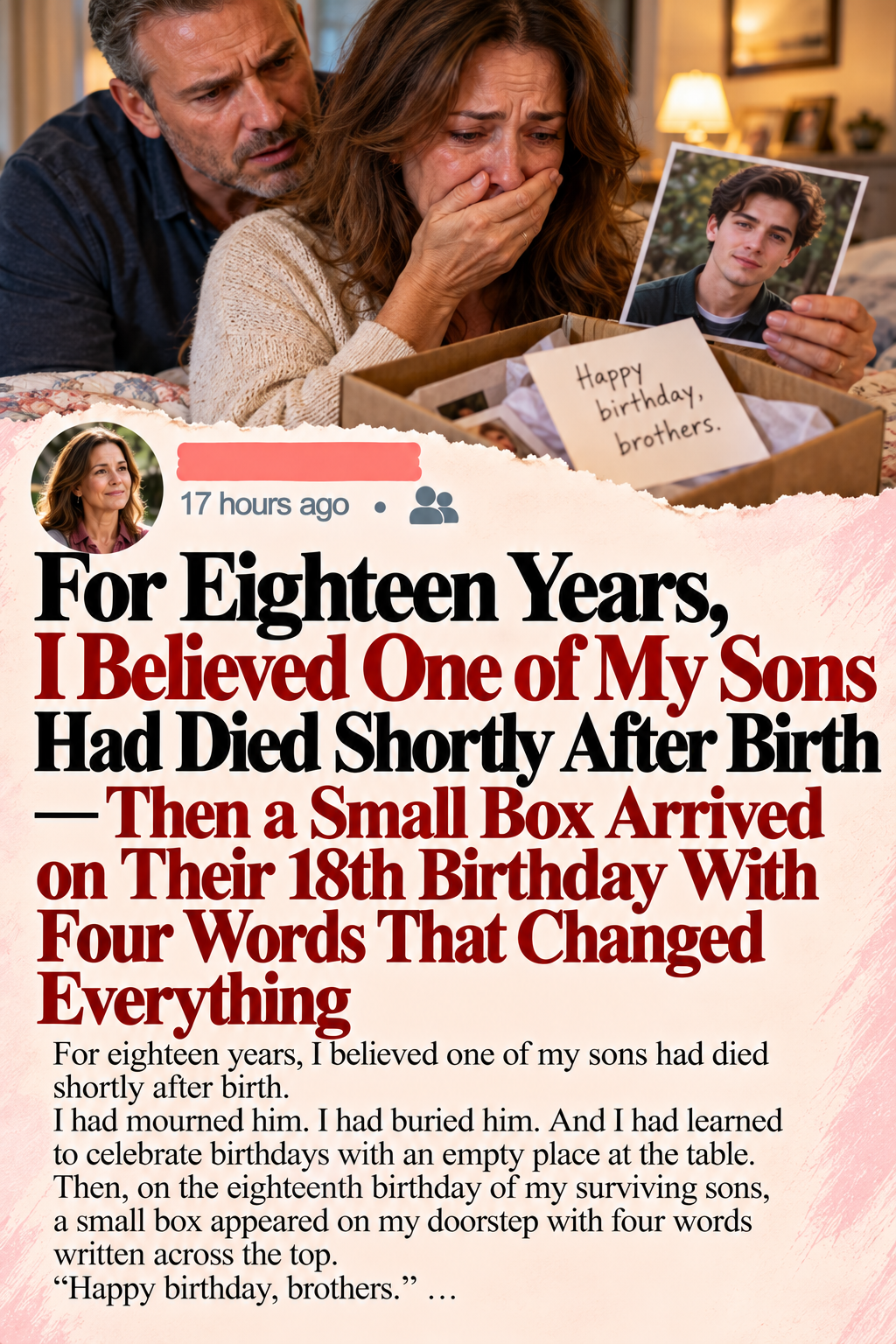
For eighteen years, I believed one of my sons had died shortly after birth.
I had mourned him. I had buried him. And I had learned to celebrate birthdays with an empty place at the table.
Then, on the eighteenth birthday of my surviving sons, a small box appeared on my doorstep with four words written across the top.
“Happy birthday, brothers.”
Those words shattered everything I thought I knew about my family.
My husband, Watson, and I had dreamed of becoming parents for years. After five long years of fertility treatments, countless appointments, and more heartbreak than we ever expected, we finally received the news we had prayed for.
I was pregnant.
But during an ultrasound, the doctor delivered another surprise.
We weren’t expecting one baby.
We were expecting three.
Triplets.
Watson and I cried, laughed, and worried about everything from cribs to diapers. Our little house suddenly seemed far too small, but neither of us cared. We were finally going to be parents.
When the boys arrived, two were healthy. The third, Rowan, needed specialized care in the neonatal intensive care unit.
Those first weeks were terrifying. I spent hours beside his incubator, holding his tiny hand whenever the nurses allowed it and whispering promises that I would always protect him.
Eventually, Rowan’s condition improved, and the doctors allowed us to bring him home.
For a few precious months, I experienced the happiness I had imagined for so long. Three little boys filled our home with cries, laughter, and sleepless nights.
Then Rowan became ill.
One moment, I was holding him against my chest. The next, Watson was calling an ambulance while I desperately tried to keep our baby comfortable.
At the hospital, everything became a blur of hurried footsteps, medical equipment, and unfamiliar faces.
Then a doctor approached us.
He looked exhausted and sorrowful.
“I’m so sorry,” he said. “We did everything we could.”
Rowan was gone.
I remember screaming. I remember Watson holding me while I struggled to understand how our baby could have been alive that morning and gone by evening.
My mother stayed with us throughout those terrible days. She helped care for the twins, organized Rowan’s funeral, and handled arrangements I was too devastated to manage.
I trusted her completely.
I never imagined that eighteen years later, I would look back on those days and question everything she had told me.
Life continued because it had to.
The twins grew into wonderful young men. They were close, protective of each other, and full of plans for their futures. Yet every birthday brought a quiet ache. I always remembered the little boy who should have been celebrating beside them.
I kept Rowan’s photographs in a small album. Sometimes, late at night, I would open it and wonder what kind of person he might have become.
Yesterday, my surviving sons turned eighteen.
Our backyard was filled with friends, music, and the smell of barbecue. The boys laughed as they opened presents, and I tried to focus on the happiness surrounding me rather than the familiar sadness in my heart.
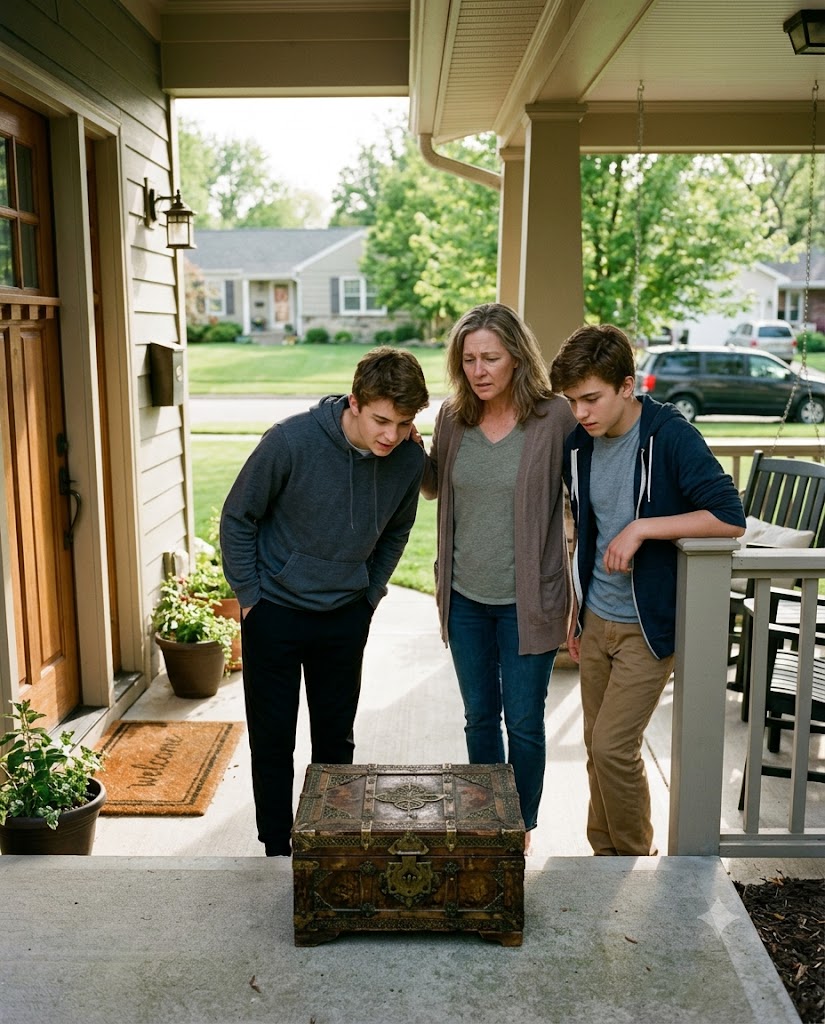
I was carrying their birthday cake toward the back door when someone knocked.
When I opened it, nobody was there.
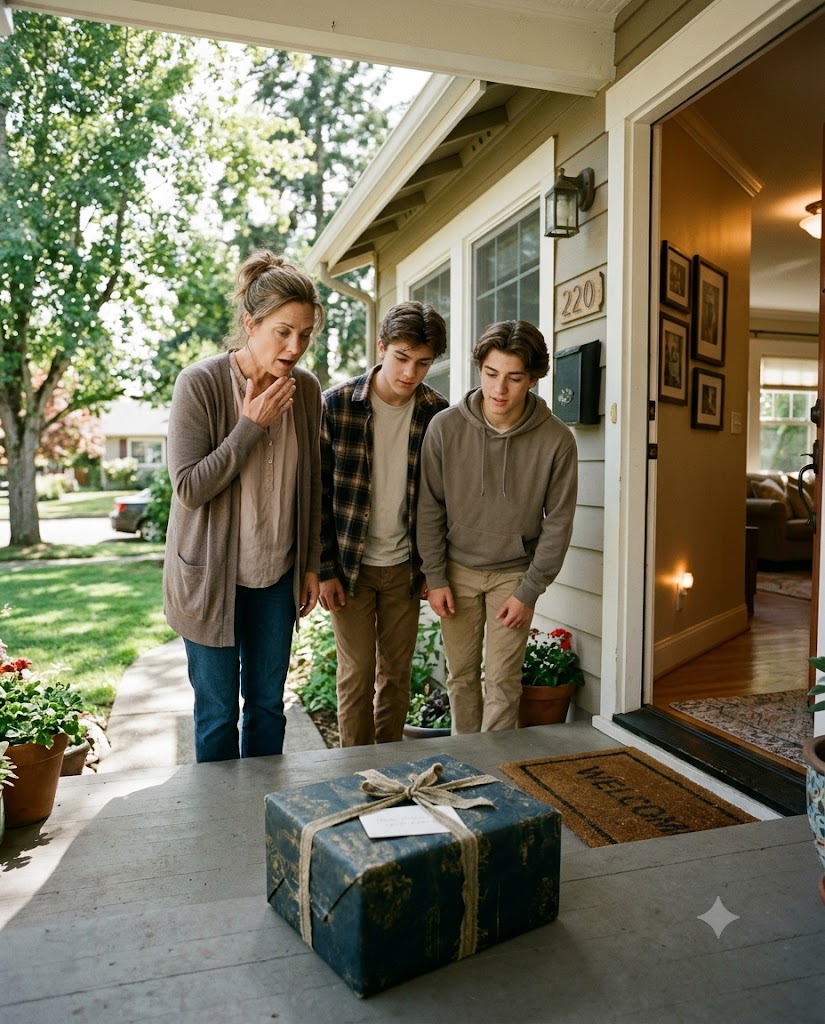
A small gift box sat on the porch.
Written across its lid in black marker were the words:
“Happy birthday, brothers.”
My hands began to tremble.
I carried the box into my bedroom, convinced that someone had made a cruel joke about the son I had lost.
But something compelled me to open it.
Inside was a folded, handwritten note.
I unfolded it carefully.
“Mom, please don’t show this to anyone until you finish reading it. Don’t trust Grandma. You won’t believe what happened eighteen years ago.”
I read those words three times.
Grandma.
My mother.
The woman who had held me while I cried over Rowan’s tiny coffin. The woman who had assured me that everything possible had been done to save him.
Why would someone warn me not to trust her?
Beneath the note was a second envelope. Inside it were several photographs and a document bearing the name of a hospital I recognized immediately.
The first photograph showed three newborn babies lying in separate bassinets.
My breath caught in my throat.
I had seen photographs of my sons before, but this image was unfamiliar. On the back, someone had written three names.
My twins’ names.
And Rowan’s.
The next photograph showed a young man standing in front of a house. He looked about eighteen, with familiar eyes and the same small dimple that appeared whenever my twins smiled.
I sank onto the edge of the bed.
The resemblance was unmistakable.
The final item was a copy of a hospital record. Several lines had been highlighted, including an entry indicating that Rowan had been transferred to another facility.
Transferred?
My son had supposedly died.
I could barely breathe as I returned to the letter.
“Mom, if you’re reading this, it means I finally found the courage to contact you. I’ve spent years trying to understand why I grew up without my biological family. What I discovered about Grandma changed everything.
“Please look at the records before you confront anyone. There are things you were never told.”
My bedroom door suddenly opened.
It was my husband, Watson.
“What’s wrong? Everyone’s asking where you went.”
I handed him the photographs without saying a word.
He stared at them, then at the document.
“Where did you get these?”
“Someone left a box outside.”
Watson examined the hospital record again. His face drained of color.
“That’s impossible,” he whispered. “We buried our son.”
“I know.”
We stood there, surrounded by the evidence of a past neither of us understood.
Then Watson noticed a telephone number written at the bottom of the letter.
We called it.
A young man’s voice answered.
“Hello?”
I struggled to speak.
“I’m sorry to ask you this, but did you send a box to my house today?”
There was a long silence.
Then he said, “Yes.”
“Who are you?”
His voice trembled.
“My name is Rowan.”
My knees nearly gave way.
Watson caught my arm as I gripped the edge of the dresser.
“Are you saying you’re my son?” I whispered.
“I believe I am. I’ve been trying to find you for months.”
Tears streamed down my face.
“Where have you been all these years?”
“I was raised by another family. They told me I was adopted, but I never knew the whole story. Recently, I found documents among my adoptive father’s belongings. They mentioned my birth mother and a woman named Eleanor.”
Eleanor was my mother.
Rowan continued.
“My adoptive parents didn’t know you had been told I died. They thought the arrangement had been made with your family’s consent. When I started asking questions, I discovered that Grandma had been involved in everything.”
I felt sick.
“Why would she do that?”
“I don’t know everything yet,” he replied. “But I have copies of the original records. I think she wanted to keep me away from you.”
I looked at Watson.
Neither of us could make sense of what we were hearing.
Then Rowan added something that made my blood run cold.
“Mom, there’s one more thing. Grandma called me last week. She knows I’ve found you. She told me that if I contacted you, I’d destroy your family.”
The line went silent.
I stared at the phone, unable to speak.
For eighteen years, I had believed that grief was the worst thing my family would ever endure.
Now I wondered whether my mother had used that grief to conceal a terrible secret.
That evening, while our guests celebrated in the backyard, Watson and I sat at the kitchen table reading every document Rowan had sent us.
The records suggested that Rowan had survived his illness. He had been transferred to another hospital, where he recovered, but the explanation for his disappearance remained unclear.
There was no credible record confirming the death we had been told about.
And the signature authorizing his transfer belonged to my mother.
I wanted to believe there had been some innocent explanation. Perhaps she had misunderstood something. Perhaps the documents were incomplete.
But why had she told me he was dead?
Why had she arranged his funeral?
And why had she never mentioned the transfer?
The following morning, I called her.
“Mom, I need you to come over. There’s something we need to discuss.”
She arrived an hour later, smiling as though nothing had changed.
Then she saw the documents on the table.
Her expression shifted.
“Where did you get those?”
I looked directly at her.
“Is Rowan alive?”
For several seconds, she didn’t answer.
Then she lowered herself into a chair and covered her face.
That was when I knew the truth was far worse than a misunderstanding.
“I thought I was protecting you,” she whispered.
“Protecting me from what?”
She began to cry.
She admitted that she had known Rowan survived. After his hospitalization, she had become involved in an arrangement that placed him with another family. She claimed she believed he would have a better chance at life elsewhere and convinced herself that keeping him away was the right decision.
But she had never given me the chance to choose.
Instead, she let me believe my baby was dead.
“You let me bury an empty space in my heart for eighteen years,” I said, my voice breaking. “You watched me grieve a child who was alive.”
My mother tried to reach for my hand.
I pulled away.
“No. You don’t get to tell me you did it out of love. You took away my son, and you took away his brothers’ chance to grow up knowing him.”
She had no answer.
Watson stood beside me, his face rigid with anger and disbelief.
We demanded every document she had kept, every name she knew, and every detail about Rowan’s childhood. Her explanations were incomplete, and some questions remained unanswered, but one truth could no longer be denied.
Rowan had survived.
And we had lost eighteen years together because someone had decided we were not entitled to know.
That afternoon, we arranged to meet him.
When Rowan arrived, I recognized him immediately from the photograph. He stood nervously at the doorway, uncertain whether he should step inside.
I walked toward him slowly.
For eighteen years, I had imagined what it would feel like to hold my son again. I had pictured his face, his voice, and the person he might become.
But no dream could prepare me for that moment.
“I’m your mother,” I whispered.
Rowan’s eyes filled with tears.
“I know.”
I reached for him, and he stepped into my arms.
We held each other while eighteen years of unanswered questions, grief, and longing seemed to pour out between us.
Then his brothers appeared.
They had heard enough of the conversation to understand what was happening. At first, they stared at Rowan in disbelief. Then one of them stepped forward.
“You’re really our brother?”
Rowan nodded through his tears.
The three of them embraced, laughing and crying at the same time.
For the first time since their birth, all three of my sons were together.
It wasn’t the childhood I had dreamed of. We couldn’t recover the birthdays, family holidays, or ordinary moments that had been stolen from us.
But we could begin again.
My relationship with my mother changed forever. I needed distance from her, and I refused to pretend that her actions were forgivable simply because she claimed to have had good intentions.
Trust would not return overnight, and some wounds might never fully heal.
Yet Rowan was alive.
That was the truth I held onto.
The small box that appeared on my sons’ eighteenth birthday had brought the most devastating revelation of my life. It had forced me to confront a betrayal I never imagined possible.
But it had also given me something I thought I had lost forever.
My son.
And as I watched all three boys sitting together in the backyard, sharing stories and discovering how much they had in common, I understood something I would never forget.
Sometimes, the truth arrives after years of silence. Sometimes, it destroys everything you thought you knew.
But even after eighteen years of loss, a family can still find its way back to the person who was missing.
That night, for the first time in eighteen years, there was no empty place in my heart where Rowan belonged.
He was home.
More stories to explore
Family Celebrated When Their Missing Son Returned After 3 Years — Until Police Discovered Who He Really Was
I Was Removing a 6-Year-Old Girl’s Cast When I Felt Something Strange — What Happened Next Sent the Entire Hospital Into Emergency Mode