I was flying from New York to Florida, expecting nothing more than a quiet few hours in the air.
I had taken the same route before, and I knew the routine by heart. Board the plane, find my seat, put my bag underneath the seat in front of me, take my medication when I needed it, and try to relax until we landed.
That day, everything seemed completely normal.
The flight attendants moved through the cabin with their usual smiles, offering drinks and small snacks. A few minutes later, they began handing out little plastic cups filled with mixed nuts.
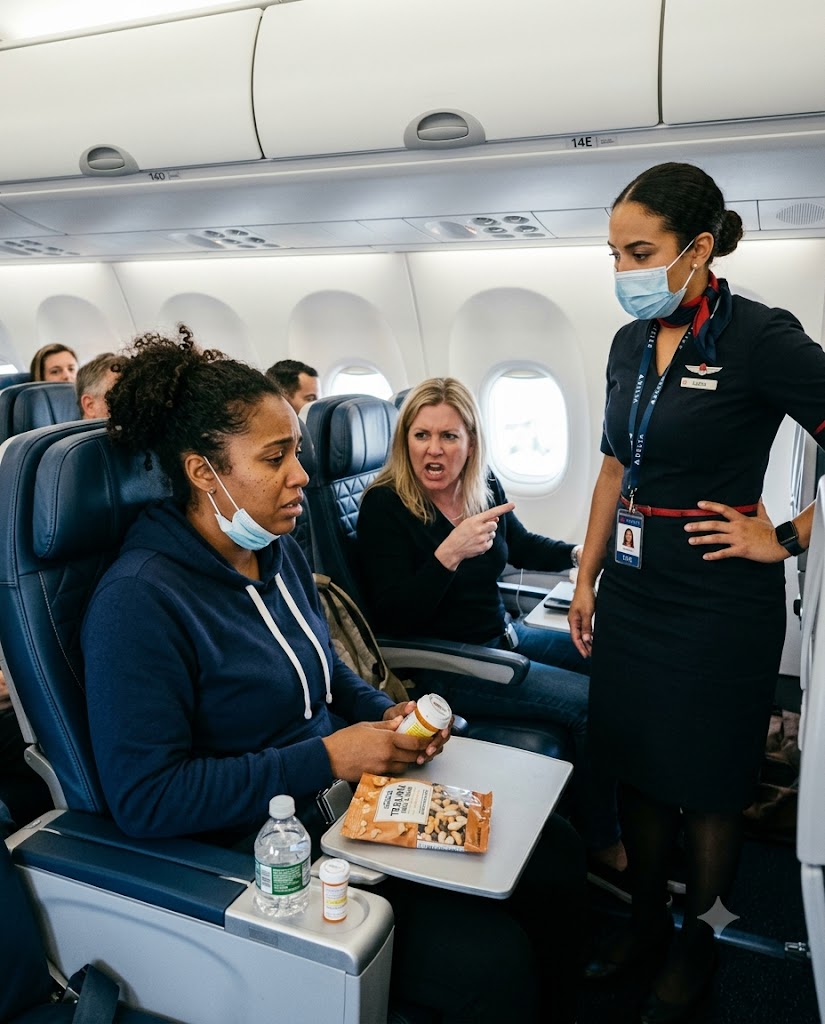
The woman sitting beside me immediately stiffened.
“I’m severely allergic to nuts,” she said.
She pushed the packet away without even touching it.
The flight attendant stopped beside our row and apologized. “Of course. I’m sorry about that.”
But the woman wasn’t satisfied.
“You should have that recorded in your system,” she said. “I specifically informed the airline about my allergy.”
The attendant checked something on her tablet before responding.
“It is recorded,” she explained calmly. “Your medical information lists an ingestion allergy. It doesn’t indicate an airborne allergy.”
The woman frowned.
“That distinction doesn’t matter.”
The attendant looked slightly confused. “I’m sorry?”
“If I’m severely allergic to nuts, then nuts shouldn’t be served on this flight. It’s dangerous.”
The attendant tried to explain that the information submitted to the airline specified the type of allergy, but the woman kept insisting that the airline should have known better.
I stayed quiet.
At that point, I honestly had no reason to get involved.
Everyone around us had been given the same little cup of nuts. Some passengers had already opened theirs. Others were eating them while watching movies or talking quietly with their companions.
Then the woman turned toward me.
“And you shouldn’t eat yours.”
I looked down at the cup in my hand.
For a second, I thought she was joking.
“Sorry?”
“You heard me. Don’t eat those.”
I glanced around the cabin. Nearly everyone in the surrounding rows had an open cup of mixed nuts.
“I’m not sure how me eating them—or not eating them—is going to change your situation,” I said.
Her expression hardened.
“It’s a matter of courtesy.”
I could feel a few people nearby beginning to listen.
I lowered my voice.
“I understand that you’re worried. But I actually need to eat something because I have to take my medication.”
She stared at me.
“You can wait.”
“I really can’t.”
I wasn’t trying to be difficult. I wasn’t trying to challenge her. I simply needed to take my medication with food, and I didn’t want to risk feeling sick during the flight.
So I tried to find a compromise.
“I’ll go to the back of the plane and eat there,” I offered. “That way, you won’t have to sit next to me while I’m eating them.”
She didn’t respond.
I gathered my medication and the snack and carefully walked toward the back of the plane.
I remember feeling embarrassed.
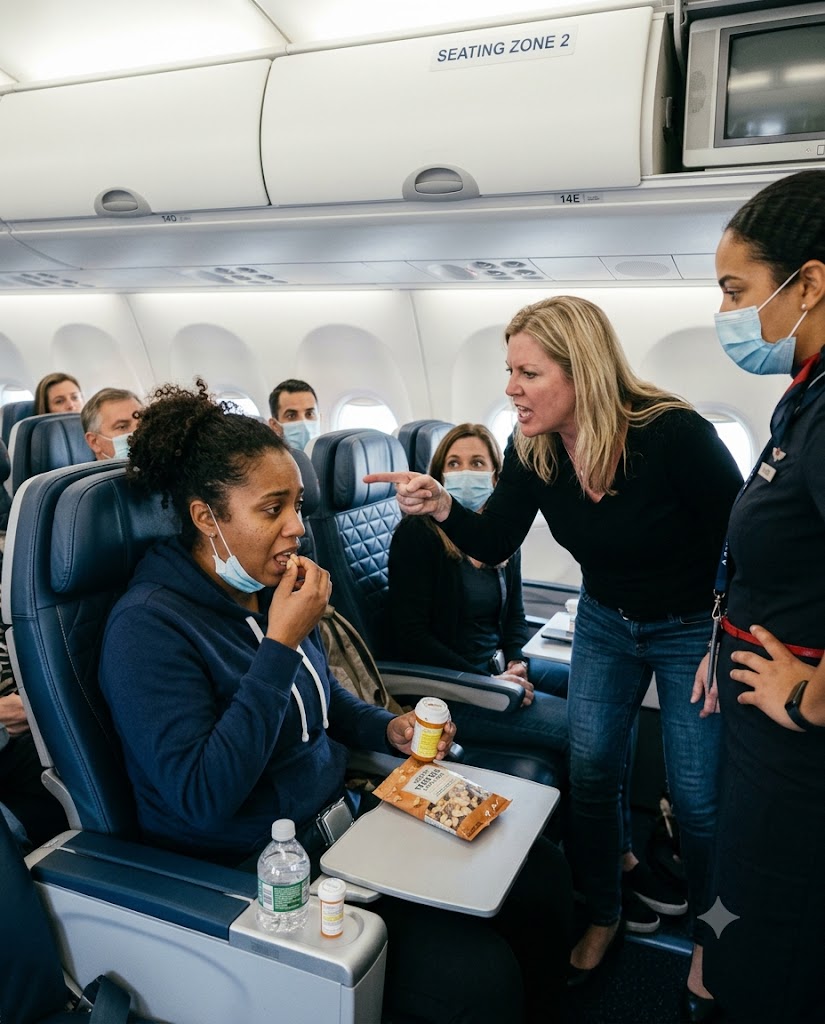
Not because I believed I had done anything wrong, but because suddenly I felt as though everyone was watching me.
I found a place where I could eat without bothering anyone, took my medication, and waited for a while before returning to my seat.
When I came back, the woman didn’t say a word.
She just sat there, staring straight ahead.
I thought that was the end of it.
I was wrong.
About ten minutes later, I heard the familiar sound of the call button.
The woman pressed it.
A flight attendant came over.
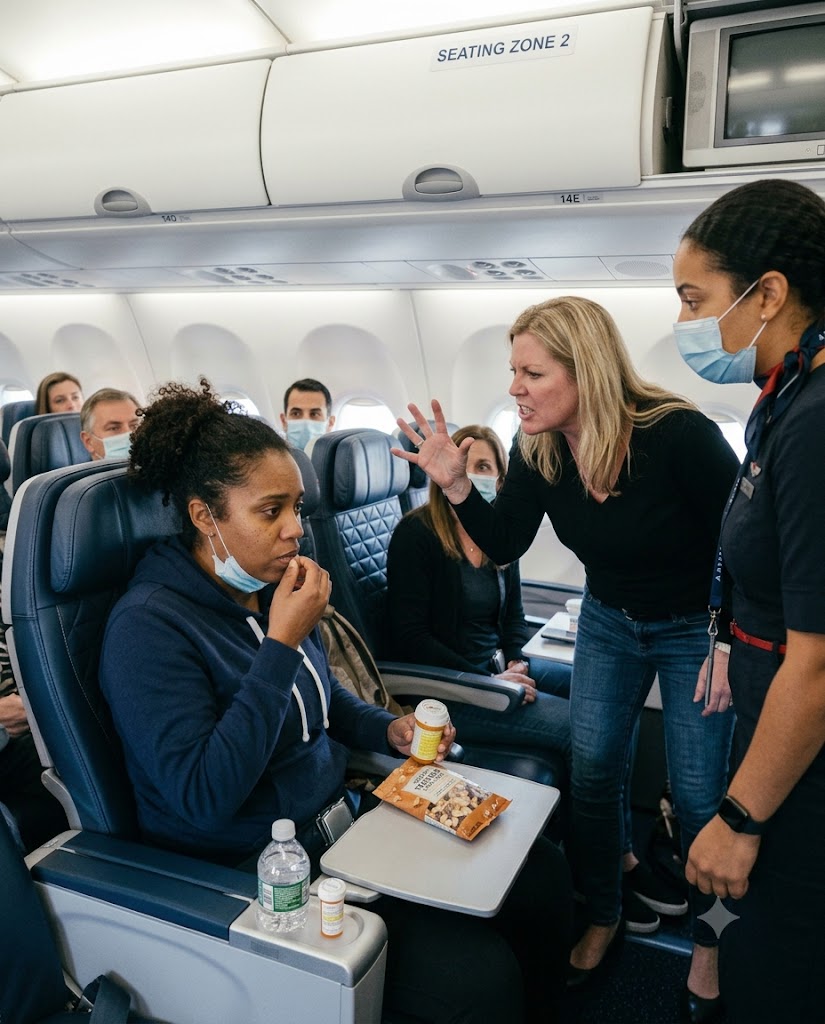
The woman pointed directly at me.
“That’s her.”
I looked up.
“What?”
“She knew I had a nut allergy and ate them anyway.”
For a moment, I genuinely couldn’t process what I was hearing.
“What?”
She repeated herself, louder.
“She knowingly endangered me.”
My stomach dropped.
I looked at the flight attendant, hoping she would understand that wasn’t what had happened.
“I went to the back of the plane to eat them,” I explained. “I told her I needed to eat because I had to take my medication. I deliberately moved away from her.”
The woman shook her head.
“She knew I was allergic.”
“I knew you said you had an allergy,” I replied. “That’s why I went to the back.”
But by then, the atmosphere around us had completely changed.
The flight attendant’s expression became serious.
She asked me a few questions, then instructed me to remain in my seat for the rest of the flight.
I couldn’t believe how quickly everything had escalated.
I sat there in silence for the remainder of the flight, staring at the seat in front of me.
I kept replaying the conversation in my head.
Had I been wrong to eat the nuts?
Should I have simply thrown them away?
Should I have skipped my medication?
Or should I have refused her request in the first place because I had done nothing to intentionally put her in danger?
The woman beside me never spoke to me again.
When we finally landed, I expected to get off the plane and forget the whole thing.
Instead, airport security was waiting at the gate.
One of the officers approached me and asked me to come with them.
My heart sank.
I tried to explain what had happened, but they told me they needed to ask me some questions.
I was separated from the other passengers and questioned about the incident.
Had I known about the woman’s allergy?
Yes.
Had I eaten nuts after she told me she was allergic?
Yes.
Had she asked me not to?
Yes.
Had I intentionally tried to expose her to the nuts?
Absolutely not.
I explained everything—the argument, my medication, my decision to move to the back of the plane, and the fact that I had returned to my seat only after I had finished eating.
Hours passed.
Eventually, no charges were filed.
But a warning was added to my record.
By then, the woman was long gone.
She had apparently continued on her journey while I was still being questioned.
The most frustrating part was that there was nothing I could do about it.
I missed my connection.
I had to buy new tickets.
Then I spent hours waiting for the next available flight.
By the time I finally sat down at the airport again, I was exhausted.
I kept thinking about how something so ordinary had turned into such a serious ordeal.
I had never imagined that eating a small cup of airline snacks could lead to airport security questioning me, a missed connection, extra expenses, and a warning on my record.
And what bothered me most wasn’t even the money.
It was the accusation.
Being told that I had “knowingly endangered” someone made me feel as though my intentions had completely disappeared from the story.
I had tried to be considerate.
I had offered to move.
I had gone to the back of the plane.
I had tried to avoid making the situation worse.
Yet somehow, I was the person being treated as though I had deliberately caused harm.
For days afterward, I kept wondering what I should have done differently.
Maybe I should have thrown the nuts away.
Maybe I should have asked the flight attendant for another snack.
Maybe I should have said nothing and simply accepted that the woman didn’t want me eating them beside her.
But another part of me couldn’t stop thinking about something else.
At what point does being considerate become surrendering your own basic needs?
I needed to eat so I could take my medication. I had even moved away from her to do it.
I never intended to hurt her.
I never wanted her to feel unsafe.
But I also don’t know whether I should simply forget what happened and move on.
The experience left me anxious about flying again, especially sitting beside a stranger who might make assumptions about me without knowing the full story.
Maybe the easiest thing would be to stay silent and let the whole experience fade away.
But I still wonder if silence is really the best way to find peace after being accused of something I never intended to do.
So now, I’m left with one question:
If you were in my position, would you simply let it go and move on—or would you look for some way to find closure after an experience like this?
More stories to explore

My Neighbor Kept Parking His Mercedes on My Lawn — But the Next Morning, He Found His Car Trapped Behind a Concrete Wall.
They Wouldn’t Let Me Inside the House I’d Cleaned for 26 Years — A Week Later, I Discovered Their Mother Had Put My Name on a Deed